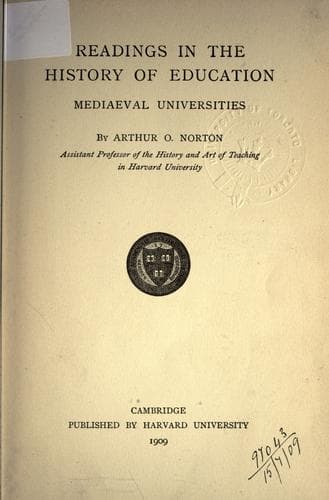
Readings in the History of Education: Mediaeval Universities — John Shaqi
Readings in the History of Education: Mediaeval UniversitiesNorton, Arthur O.
History
Readings in the History of Education: Mediaeval Universities
Norton, Arthur O.
Education, Medieval -- History -- Sources; Universities and colleges -- Europe
The history of education, like all other branches of history, is based
upon documents. Historical documents are, in general, "the traces which
have been left by the thoughts and actions of men of former times"; the
term commonly refers to the original records or _sources_ from which our
knowledge of historical facts is derived. The documents most generally
used by historians are written or printed. In the history of education
alone these are of the greatest variety; as is shown in the following
pages, among them are university charters, proceedings, regulations,
lectures, text-books, the statutes of student organizations, personal
letters, autobiographies, contemporary accounts of university life, and
laws made by civil or ecclesiastical authorities to regulate university
affairs. Similar varieties of records exist for other educational
institutions and activities. The immense masses of such written or
printed materials produced to-day, even to the copy-book of the primary
school and the student's note-book of college lectures, will, if they
survive, become documents for the future historian of education.
The known sources for the history of education in western Europe since
the twelfth century--to go no further afield--are exceedingly numerous,
and widely spread among various public and private collections; the
labor of a lifetime would hardly suffice to examine them all critically.
Nevertheless many printed and written documents have been collected,
edited, and published in their original languages; and in some instances
the collections are fairly complete, or at least fairly representative
of the documents in existence. Assuming that they are accurate copies of
the original records, many are now easily accessible to students of the
subject, since these reproductions may be owned by all large libraries.
These records, rightly apprehended, have far more than a mere
antiquarian interest. The history of mediaeval universities is
profoundly important, not only for students, but also for
administrators, of modern higher education. For to a surprising degree
the daily and hourly conduct of university affairs of the twentieth
century is influenced by what universities did six centuries ago. On
this point the words of Mr. Hastings Rashdall, a leading authority on
mediaeval universities, are instructive: "... If we would completely
understand the meaning of offices, titles, ceremonies, organizations
preserved in the most modern, most practical, most unpicturesque of the
institutions which now bear the name of 'University,' we must go back to
the earliest days of the earliest Universities that ever existed, and
trace the history of their chief successors through the seven centuries
that intervene between the rise of Bologna or Paris, and the foundation
of the new University of Strassburg in Germany, or of the Victoria
University in England."
Public-domain text, read in full here on John Shaqi.
Reviews
Reviews
No reviews yet
Be the first to share your thoughts on this work.
Join the Discussion
Join the discussion
Sign in to leave a comment or review.
Sign InorCreate an account