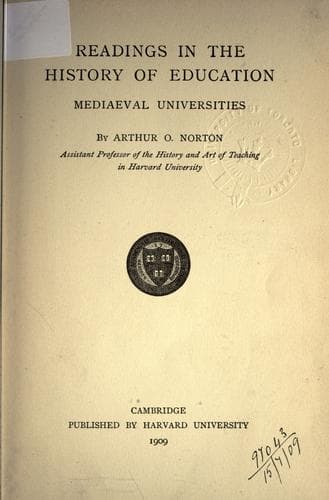
Readings in the History of Education: Mediaeval UniversitiesNorton, Arthur O.
History
Readings in the History of Education: Mediaeval Universities
Norton, Arthur O.
Education, Medieval -- History -- Sources; Universities and colleges -- Europe
The form, moreover, to be observed by the Doctors as to the
sections is this: Let the division of the book into sections
(_puncta_) be determined, and then let him be notified. [And if
any Doctor fails to reach any section on the specified date he
shall be fined three Bologna pounds, while for a second offense
he shall be fined five pounds, and for a third and each
succeeding violation of the rule, ten pounds.] And if the
twenty-five pounds are exhausted, he must deposit in said place a
second twenty-five pounds; and the second deposit must be made
within eight days from the time when the first was exhausted....
We decree also that no Doctor shall hereafter exceed one section
in one lecture. And if the contrary be done by any one he shall
be charged with perjury and punished to the extent of three
pounds, to be taken from the money deposited for the purpose; and
as often as the violation occurs, so often shall the penalty be
inflicted, so long as the statute is in force; and the Rector
also must exact it.
We add that at the end of a section the Doctors must announce to
the scholars at what section they are to begin afterwards, and
they shall be obliged to follow that section which they have
begun, even to the end of the section. But if by chance, after
due weight is given to the glosses or text, it seems useful to
transfer a part of the lecture to another section, he shall be
obliged in his preceding lecture to announce that to the
scholars, so that those who wish may make provision beforehand;
under penalty of five Bologna shillings for each occasion for the
Doctor who does to the contrary.
We order this statute to be published in each school at the
beginning of the term....
Since topics not read by the Doctors are completely neglected
and consequently are not known to the scholars, we have decreed
that no Doctor shall omit from his sections any chapter,
decretal, law, or paragraph. If he does this he shall be obliged
to read it within the following section. We have also decreed
that no decretal or decree or law or difficult paragraph shall be
reserved to be read at the end of the lecture if, through such
reservation, promptness of exit at the sound of the appointed
bell is likely to be prevented.[59]
A lecture might be either dictated or delivered rapidly, "to the minds
rather than to the pens," of the auditors. For pedagogic and possibly
other reasons, the latter method seems to have been preferred by the
authorities; but lecturers, and students who desire to get full notes,
seem to have insisted upon dictation. A statute of the Masters of Arts
at Paris, 1355, is one of several unsuccessful attempts to enforce rapid
delivery:
Public-domain text, read in full here on John Shaqi.
Reviews
Reviews
No reviews yet
Be the first to share your thoughts on this work.
Elsewhere in the archive
Join the Discussion
Join the discussion
Sign in to leave a comment or review.
Sign InorCreate an account