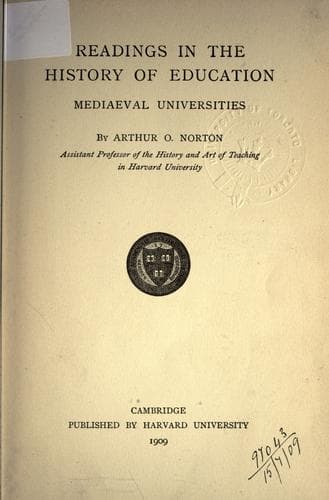
Readings in the History of Education: Mediaeval UniversitiesNorton, Arthur O.
History
Readings in the History of Education: Mediaeval Universities
Norton, Arthur O.
Education, Medieval -- History -- Sources; Universities and colleges -- Europe
Two methods of reading the books of the Liberal Arts have been
tried: By the first, the Masters of Philosophy from their chairs
rapidly set forth their own words, so that the mind of the
listener can take them in, but his hand is not able to write them
down; by the second, they pronounce them slowly so that the
listeners are able to write them down in their presence with the
pen. By diligent examination and mutual comparison of these ways
the first method is found to be the better, because the
conceptual power of the ordinary mind warns us to imitate it in
our lectures. Therefore, we, one and all, Masters of Arts, both
lecturing and not lecturing, being especially convoked for this
purpose ... have made a statute to this effect: All lecturers,
Masters as well as Scholars, of the same Faculty, whenever and
wherever they happen to be reading any book in regular order or
course in the same Faculty, or to be discussing a question
according to this or any other method of exposition, shall follow
the former method of reading to the best of their ability, to
wit: presenting it as though no one were writing it in their
presence. It is in accordance with this method that discourses
and recommendations are made in the University, and it is
followed by Lecturers in the rest of the Faculties.
Transgressors of this Statute, whether Masters or Scholars, we
deprive thenceforth of their positions as lecturers, of honors,
offices, and the rest of their means of support under our
Faculty, for one year. But if any one repeats the offense, we
double the penalty for the first repetition; for the second, we
quadruple it, and so on. And auditors who interfere with the
execution of this our Statute by shouting or whistling or raising
a din, or by throwing stones, either personally or through their
attendants or accomplices, or in any other way, we deprive of and
cut off from our company for one year, and for each repetition we
increase the penalty to twice and four times the length as
above.[60]
(b) _The Disputation._
Public-domain text, read in full here on John Shaqi.
Reviews
Reviews
No reviews yet
Be the first to share your thoughts on this work.
Elsewhere in the archive
Join the Discussion
Join the discussion
Sign in to leave a comment or review.
Sign InorCreate an account