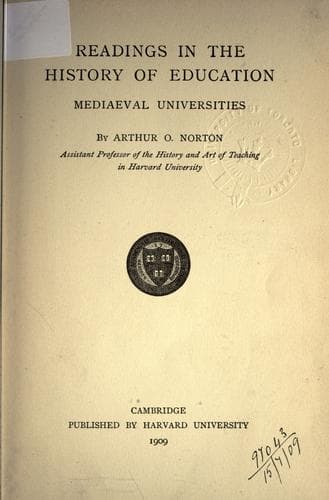
Readings in the History of Education: Mediaeval UniversitiesNorton, Arthur O.
History
Readings in the History of Education: Mediaeval Universities
Norton, Arthur O.
Education, Medieval -- History -- Sources; Universities and colleges -- Europe
The disputation, or debate, one of the most important university
exercises, "first became really established in the schools as a result
of the new method." (Cf. page 35.) This exercise was sometimes carried
on in the manner of a modern debate; to "respond" in the schools (i.e.,
to defend a thesis in public debate), and to "oppose" (i.e., to argue
against the respondent), was a common requirement for all degrees.
Scholars and masters frequently posted in public places theses to the
argument of which they challenged all comers, just as a knight might
challenge all comers at a tournament to combat. In such cases the
respondent usually indicated the side of the question which he would
defend. This practice, in a modified form, still exists in some European
universities in the public examinations for the Doctor's degree.
In another mode, the disputation was carried on by a single person, who
argued both sides of the question and drew the conclusion in favor of
one side or the other. This was of course merely the oral use of the
method of exposition commonly found in the works of scholastic
philosophers and theologians. The lecture of Giraldus Cambrensis
described above (page 109) was doubtless of this type. A complete
example is to be found in Dante's "Quaestio de Aqua et Terra." The brief
of the arguments on both sides of this question is here reproduced with
some modifications. It illustrates not only the exercise itself, but
also the ponderous complications which the scholastic method received at
the hands of Abelard's successors, and the weakness of that method when
applied to questions of natural science. The reader will note that the
argument no longer proceeds by the simple citation of authorities pro
and con; the reasonings of the debater are also introduced. Moreover,
the argument is more complex. It involves first the statement of the
affirmative position; second, the refutation of the affirmative by
observation and by reasoning; third, objections to the refutation by
reasoning; fourth, refutation of these objections; fifth, final
refutation of the original arguments.
_Introduction_: Author's reasons for undertaking the discussion.
Public-domain text, read in full here on John Shaqi.
Reviews
Reviews
No reviews yet
Be the first to share your thoughts on this work.
Elsewhere in the archive
Join the Discussion
Join the discussion
Sign in to leave a comment or review.
Sign InorCreate an account