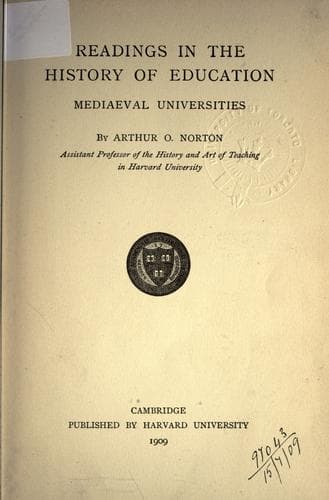
Readings in the History of Education: Mediaeval UniversitiesNorton, Arthur O.
History
Readings in the History of Education: Mediaeval Universities
Norton, Arthur O.
Education, Medieval -- History -- Sources; Universities and colleges -- Europe
D. _Refutation of the original arguments_:
_Reason 1._ Invalid because Earth and Water are spheres
with the same center.
_Reason 2._ Invalid because of the external influence of
Universal Nature, counteracting the internal influence
of Particular Nature.
_Reason 3._ Invalid because it is sphericity of the sea and
not the lowness of the land which interferes with one's
view at sea.
_Reason 4._ Invalid because Water does not flow to the
tops of mountains, but ascends thither in the form of
vapors.
_Reason 5._ Invalid because Water imitating the moon in
one respect, need not imitate it in all.[61]
This brief obviously illustrates much more than the form of the
mediaeval Disputation. It leaves one in no doubt as to the difference
between the natural science of the Middle Ages and that of our own time.
It also illustrates the weakness of the scholastic method when applied
to questions which modern science would settle by experiment. The
argument abounds in misstatements of fact, the conclusion is incorrect,
and the "reasoning" by which it is reached can be described, from the
modern point of view, only as grotesque. The weakness of the method was
recognized by Roger Bacon so early as the thirteenth century. The
growing recognition of its futility finds repeated expression in the
sixteenth and seventeenth centuries, notably in the New Method (Novum
Organum) of Francis Bacon.
Like the scholastic method and the worship of Aristotle, the Disputation
fell into disrepute because of the extravagant lengths to which it was
carried. The following sarcastic criticism by the Spanish scholar, Juan
Luis Vives (1462-1540), is one illustration of the growing revolt of his
times against it:
Disputations, also, to no slight degree have blinded judgment.
They were instituted originally (but only among young men) to
stimulate mental vigor, often torpid, and to make young men
keener in their studies, so that they might either conquer or not
be conquered, and also that the instruction received from their
teachers might be more deeply impressed upon them.
Among men, or older persons, there was a kind of comparison of
opinions and reasons, not aimed at victory but at unravelling the
truth. The very name testifies that they are called disputations
because by their means the truth is, as it were, pruned or purged
[dis = apart; puto = to prune, or to cleanse]. But after praise
and reward came from listeners to the one who seemed to have the
best ideas, and out of the praise often came wealth and
resources, a base greed of distinction or money took possession
of the minds of the disputants, and, just as in a battle, victory
only was the consideration, and not the elucidation of truth. So
that they defended strenuously whatever they once had said, and
overthrew and trampled upon their adversary.
Public-domain text, read in full here on John Shaqi.
Reviews
Reviews
No reviews yet
Be the first to share your thoughts on this work.
Elsewhere in the archive
Join the Discussion
Join the discussion
Sign in to leave a comment or review.
Sign InorCreate an account