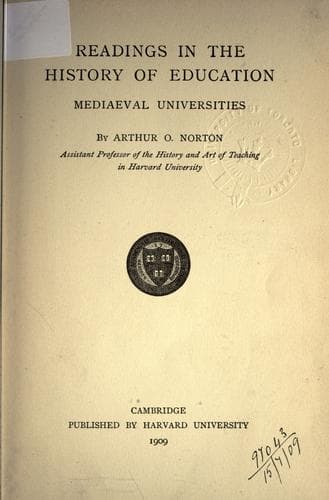
Readings in the History of Education: Mediaeval UniversitiesNorton, Arthur O.
History
Readings in the History of Education: Mediaeval Universities
Norton, Arthur O.
Education, Medieval -- History -- Sources; Universities and colleges -- Europe
Low and sordid minds such as with drooping heads look solely at
such trivial and ephemeral results, regarded as of small
consequence the great benefit that results from study:--namely
probity or knowledge of truth; and these two things they did not
regard with sufficient acuteness nor did they comprehend their
great value, but they sought the immediate reward of money or
popular favor.
And so, in order to get a greater return for their labor, they
admitted the populace to their contests like the spectators of a
play brought out at the theatre. Then, as one might expect when
the standard is lowered, the philosopher laid aside his
dignified, venerable character, and put on his stage dress that
he might dance more easily: the populace was made spectator,
umpire, and judge, and the philosopher did that which the flute
player does not do on the stage,--he suited his music, not to his
own ideas and to the Muses, as his old teacher advises, but
wholly to the circle of onlookers and the crowd whence
distinction and gain was likely to come back to the actors.
There was no need of real, solid teaching (at least, not in the
opinion of those who are going to learn); but pretence and dust
were thrown in the eyes of the crowd. So the one plain road of
obtaining the truth was abandoned; six hundred ways of pretending
were made, by which each strove for what suited himself,
especially since there is nothing made so ugly as to lack a
sponsor.
Public-domain text, read in full here on John Shaqi.
Reviews
Reviews
No reviews yet
Be the first to share your thoughts on this work.
Elsewhere in the archive
Join the Discussion
Join the discussion
Sign in to leave a comment or review.
Sign InorCreate an account