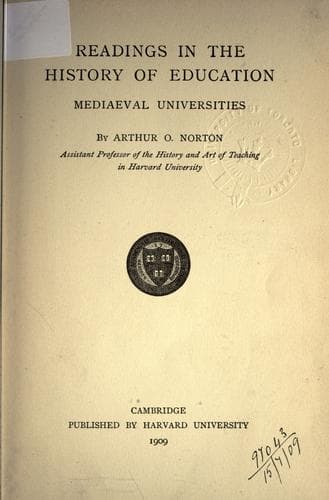
Readings in the History of Education: Mediaeval UniversitiesNorton, Arthur O.
History
Readings in the History of Education: Mediaeval Universities
Norton, Arthur O.
Education, Medieval -- History -- Sources; Universities and colleges -- Europe
Courtesans in charge of a panderer do not wrangle so many times,
or gladiators in charge of a trainer do not fight so many times
for a prize as these do under their teacher of philosophy. The
populace, not self-restrained and serious, but fickle, barbarous,
pugnacious, is wonderfully tickled with all this as with a mock
battle. So there are very many exceedingly ignorant men, utterly
without knowledge of literature in any form, who take more
pleasure in this form of show than in all else; and the more
easily to win the fight, they employ a quick and prompt mode of
fighting and deliver a blow every second, as it were, in order
the more speedily to use up their foe. They neither assail their
adversary with uninterrupted argument nor can they endure
prolonged talk from him. If by way of explaining himself he
should begin to enlarge, they raise the cry: "To the point! To
the point! Answer categorically!" Showing how restless and
flippant _their_ minds are who cannot stand a few words....
To such a degree did they go that instead of a settlement based
on the strongest arguments, such as drove them into their
absurdities, they considered it sufficient to say: "I admit it,
for it follows from my own conclusion," and the next step is: "I
deny it. Prove it. I will defend it appropriately." For he who
"defends appropriately" (in their own words), no matter by what
incongruous admissions and concessions, is held to be a learned
man and best adapted to disputation, that is, to the apex of all
knowledge.
(c) _The Examination_
The examination, as an exercise leading to a degree, is one phase of
modern educational practice which comes from mediaeval universities. The
system of examinations grew up slowly. Generalization is difficult owing
to the differences in practice in various universities, but broadly
speaking the student who took a Master's or Doctor's degree in any
Faculty passed through the three stages of Bachelor, Licentiate, and
Doctor, and at each stage underwent some form of examination. The
examination for the License (to teach anywhere) seems to have been the
most formidable of the three; that for the Doctorate being mainly
ceremonial. In general, the examination tested the candidate's knowledge
of the books prescribed, and his power of public debate.
The statutes of Bourges (c. 1468-1480) thus describe the requirements
and the manner of procedure of examinations for the License in Arts:
[In preparation for the A.B. degree, which preceded the License, the
candidate had heard lectures on (1) The Isagoge (Introduction) of
Porphyry to the Categories of Aristotle, (2) the following works of
Aristotle: (a) Categories; (b) Peri Hermeneias (On Interpretation), the
first (?) two books and a part of the fourth; (c) Topics, first book;
(d) Physics, first three books.]
Public-domain text, read in full here on John Shaqi.
Reviews
Reviews
No reviews yet
Be the first to share your thoughts on this work.
Elsewhere in the archive
Join the Discussion
Join the discussion
Sign in to leave a comment or review.
Sign InorCreate an account