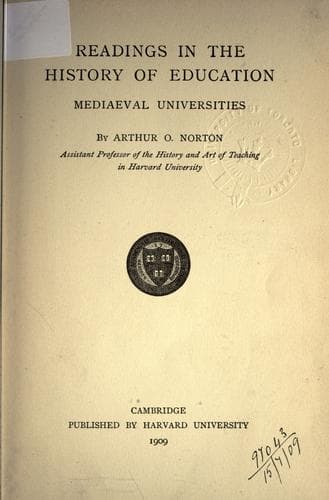
Readings in the History of Education: Mediaeval UniversitiesNorton, Arthur O.
History
Readings in the History of Education: Mediaeval Universities
Norton, Arthur O.
Education, Medieval -- History -- Sources; Universities and colleges -- Europe
Not only did the populace flock to this opinion--that the object
of learning is to dispute, just as it is the object of military
life to fight--but the public unanimity swept away the veterans,
the _triarii_ [the more experienced soldiers who were placed in
the third line] as it were, of the scholastic campaign (but these
have no more ability and judgment than the dregs of the people),
so that they regard him as superfluous and foolish who would call
them back to mental activity and character and that quiet method
of investigation, philosophy. [They think that] there is no other
fruit of studies save to keep your wits about you and not give
way to your adversary, either to attack him boldly or to bear up
against him, and shrewdly to contrive by what vigor, by what
skill, by what method of supplanting, he may be overturned.
Therefore under this beautiful scheme, surpassing all others, it
was the plan to break in the boy immediately and train him
constantly; they began disputing as soon as they were born and
ceased only at death. The boy brought to school, is bidden to
dispute forthwith on the first day and is already taught to
quarrel, before he can yet speak at all. So also in Grammar, in
the Poets, in the Historians, in Logic, in Rhetoric, in
absolutely every branch. Would any one wonder what they can find
to do in matters that are perfectly open, very simple and
elementary? There is nothing so transparent, so limpid that they
do not cloud it over with some petty question as if ruffled by a
breeze. It is [thought] characteristic of the most helpless
stupidity, not to find something which you may make obscure by
most intricate measures and involve in very hard and rigid
conditions, which you may twist and twist again. For you may
simply say: "Write to me,"--here comes a question, if not from
Grammar then from Logic, if not from Logic then from
Physics,--"What motions are made in writing?" Or, from
Metaphysics, "Is it substance or quality?"
And these boys are hearing the first rudiments of Logic who were
only yesterday, or the day before, admitted to the school. So
they are to be trained never to be silent, but vigorously to
assert whatever comes uppermost lest they may seem at any time to
have given in. Nor is one dispute a day enough, nor two, like a
meal. At lunch they dispute, after lunch they dispute, at dinner
they dispute, after dinner they dispute. Do they do these things
to learn, or to cook a new dish? They dispute at home, they
dispute away from home. At a banquet, in the bath, in the
tepidarium, at church, in the city, in the fields, in public, in
private, in all places and at all times they dispute.
Public-domain text, read in full here on John Shaqi.
Reviews
Reviews
No reviews yet
Be the first to share your thoughts on this work.
Elsewhere in the archive
Join the Discussion
Join the discussion
Sign in to leave a comment or review.
Sign InorCreate an account