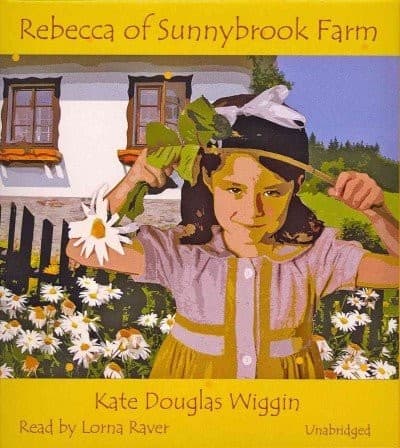
Rebecca of Sunnybrook FarmWiggin, Kate Douglas Smith
General
Rebecca of Sunnybrook Farm
Wiggin, Kate Douglas Smith
Aunts -- Juvenile fiction; Girls -- Juvenile fiction; New England -- Juvenile fiction
Riverboro being poorly furnished with
beaux, she intended to have as good a time during her four years at
Wareham as circumstances would permit. Her idea of pleasure was an
ever-changing circle of admirers to fetch and carry for her, the more
publicly the better; incessant chaff and laughter and vivacious
conversation, made eloquent and effective by arch looks and telling
glances. She had a habit of confiding her conquests to less fortunate
girls and bewailing the incessant havoc and damage she was doing; a
damage she avowed herself as innocent of, in intention, as any new-born
lamb. It does not take much of this sort of thing to wreck an ordinary
friendship, so before long Rebecca and Emma Jane sat in one end of the
railway train in going to and from Riverboro, and Huldah occupied the
other with her court. Sometimes this was brilliant beyond words,
including a certain youthful Monte Cristo, who on Fridays expended
thirty cents on a round trip ticket and traveled from Wareham to
Riverboro merely to be near Huldah; sometimes, too, the circle was
reduced to the popcorn-and-peanut boy of the train, who seemed to serve
every purpose in default of better game.
Rebecca was in the normally unconscious state that belonged to her
years; boys were good comrades, but no more; she liked reciting in the
same class with them, everything seemed to move better; but from vulgar
and precocious flirtations she was protected by her ideals. There was
little in the lads she had met thus far to awaken her fancy, for it
habitually fed on better meat. Huldah's school-girl romances, with
their wealth of commonplace detail, were not the stuff her dreams were
made of, when dreams did flutter across the sensitive plate of her mind.
Among the teachers at Wareham was one who influenced Rebecca
profoundly, Miss Emily Maxwell, with whom she studied English
literature and composition. Miss Maxwell, as the niece of one of
Maine's ex-governors and the daughter of one of Bowdoin's professors,
was the most remarkable personality in Wareham, and that her few years
of teaching happened to be in Rebecca's time was the happiest of all
chances. There was no indecision or delay in the establishment of their
relations; Rebecca's heart flew like an arrow to its mark, and her
mind, meeting its superior, settled at once into an abiding attitude of
respectful homage.
It was rumored that Miss Maxwell "wrote," which word, when uttered in a
certain tone, was understood to mean not that a person had command of
penmanship, Spencerian or otherwise, but that she had appeared in print.
"You'll like her; she writes," whispered Huldah to Rebecca the first
morning at prayers, where the faculty sat in an imposing row on the
front seats. "She writes; and I call her stuck up."
Public-domain text, read in full here on John Shaqi.
Reviews
Reviews
No reviews yet
Be the first to share your thoughts on this work.
Elsewhere in the archive
Join the Discussion
Join the discussion
Sign in to leave a comment or review.
Sign InorCreate an account