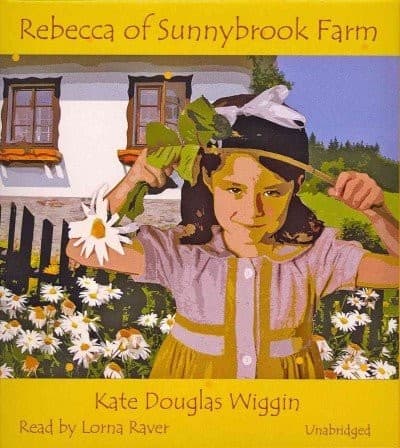
Rebecca of Sunnybrook FarmWiggin, Kate Douglas Smith
General
Rebecca of Sunnybrook Farm
Wiggin, Kate Douglas Smith
Aunts -- Juvenile fiction; Girls -- Juvenile fiction; New England -- Juvenile fiction
"Yes, but where did they get that beautiful polish, that satin skin,
that lovely shape, Rebecca? Not in the still pool lying on the sands.
It was never there that their angles were rubbed off and their rough
surfaces polished, but in the strife and warfare of running waters.
They have jostled against other pebbles, dashed against sharp rocks,
and now we look at them and call them beautiful."
"If Fate had not made somebody a teacher,
She might have been, oh! such a splendid preacher!"
rhymed Rebecca. "Oh! if I could only think and speak as you do!" she
sighed. "I am so afraid I shall never get education enough to make a
good writer."
"You could worry about plenty of other things to better advantage,"
said Miss Maxwell, a little scornfully. "Be afraid, for instance, that
you won't understand human nature; that you won't realize the beauty of
the outer world; that you may lack sympathy, and thus never be able to
read a heart; that your faculty of expression may not keep pace with
your ideas,--a thousand things, every one of them more important to the
writer than the knowledge that is found in books. AEsop was a Greek
slave who could not even write down his wonderful fables; yet all the
world reads them."
"I didn't know that," said Rebecca, with a half sob. "I didn't know
anything until I met you!"
"You will only have had a high school course, but the most famous
universities do not always succeed in making men and women. When I long
to go abroad and study, I always remember that there were three great
schools in Athens and two in Jerusalem, but the Teacher of all teachers
came out of Nazareth, a little village hidden away from the bigger,
busier world."
"Mr. Ladd says that you are almost wasted on Wareham," said Rebecca
thoughtfully.
"He is wrong; my talent is not a great one, but no talent is wholly
wasted unless its owner chooses to hide it in a napkin. Remember that
of your own gifts, Rebecca; they may not be praised of men, but they
may cheer, console, inspire, perhaps, when and where you least expect.
The brimming glass that overflows its own rim moistens the earth about
it."
"Did you ever hear of The Rose of Joy?" asked Rebecca, after a long
silence.
"Yes, of course; where did you see it?"
"On the outside of a book in the library."
"I saw it on the inside of a book in the library," smiled Miss Maxwell.
"It is from Emerson, but I'm afraid you haven't quite grown up to it,
Rebecca, and it is one of the things impossible to explain."
"Oh, try me, dear Miss Maxwell!" pleaded Rebecca. "Perhaps by thinking
hard I can guess a little bit what it means."
"'In the actual--this painful kingdom of time and chance--are Care,
Canker, and Sorrow; with thought, with the Ideal, is immortal
hilarity--the rose of Joy; round it all the Muses sing,'" quoted Miss
Maxwell.
Public-domain text, read in full here on John Shaqi.
Reviews
Reviews
No reviews yet
Be the first to share your thoughts on this work.
Elsewhere in the archive
Join the Discussion
Join the discussion
Sign in to leave a comment or review.
Sign InorCreate an account