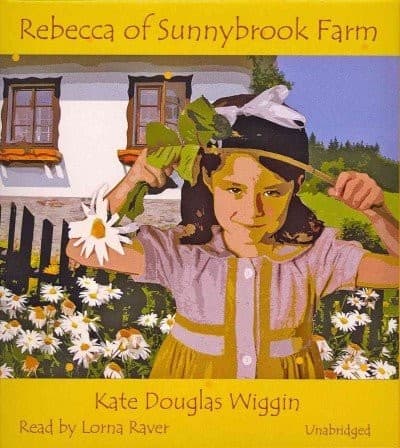
Rebecca of Sunnybrook FarmWiggin, Kate Douglas Smith
General
Rebecca of Sunnybrook Farm
Wiggin, Kate Douglas Smith
Aunts -- Juvenile fiction; Girls -- Juvenile fiction; New England -- Juvenile fiction
"Don't you dare answer me back that imperdent way, Rebecca, tellin' me
I'm mean; your father was a vain, foolish, shiftless man, an' you might
as well hear it from me as anybody else; he spent your mother's money
and left her with seven children to provide for."
"It's s-something to leave s-seven nice children," sobbed Rebecca.
"Not when other folks have to help feed, clothe, and educate 'em,"
responded Miranda. "Now you step upstairs, put on your nightgown, go to
bed, and stay there till to-morrow mornin'. You'll find a bowl o'
crackers an' milk on your bureau, an' I don't want to hear a sound from
you till breakfast time. Jane, run an' take the dish towels off the
line and shut the shed doors; we're goin' to have a turrible shower."
"We've had it, I should think," said Jane quietly, as she went to do
her sister's bidding. "I don't often speak my mind, Mirandy; but you
ought not to have said what you did about Lorenzo. He was what he was,
and can't be made any different; but he was Rebecca's father, and
Aurelia always says he was a good husband."
Miranda had never heard the proverbial phrase about the only "good
Indian," but her mind worked in the conventional manner when she said
grimly, "Yes, I've noticed that dead husbands are usually good ones;
but the truth needs an airin' now and then, and that child will never
amount to a hill o' beans till she gets some of her father trounced out
of her. I'm glad I said just what I did."
"I daresay you are," remarked Jane, with what might be described as one
of her annual bursts of courage; "but all the same, Mirandy, it wasn't
good manners, and it wasn't good religion!"
The clap of thunder that shook the house just at that moment made no
such peal in Miranda Sawyer's ears as Jane's remark made when it fell
with a deafening roar on her conscience.
Perhaps after all it is just as well to speak only once a year and then
speak to the purpose.
Rebecca mounted the back stairs wearily, closed the door of her
bedroom, and took off the beloved pink gingham with trembling fingers.
Her cotton handkerchief was rolled into a hard ball, and in the
intervals of reaching the more difficult buttons that lay between her
shoulder blades and her belt, she dabbed her wet eyes carefully, so
that they should not rain salt water on the finery that had been worn
at such a price. She smoothed it out carefully, pinched up the white
ruffle at the neck, and laid it away in a drawer with an extra little
sob at the roughness of life. The withered pink rose fell on the floor.
Rebecca looked at it and thought to herself, "Just like my happy day!"
Nothing could show more clearly the kind of child she was than the fact
that she instantly perceived the symbolism of the rose, and laid it in
the drawer with the dress as if she were burying the whole episode with
all its sad memories. It was a child's poetic instinct with a dawning
hint of woman's sentiment in it.
Public-domain text, read in full here on John Shaqi.
Reviews
Reviews
No reviews yet
Be the first to share your thoughts on this work.
Join the Discussion
Join the discussion
Sign in to leave a comment or review.
Sign InorCreate an account