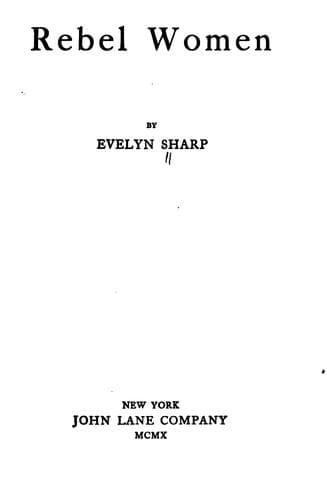
Women -- Great Britain -- Social conditions; Women -- Suffrage -- Great Britain
She thought of a hundred things, many of them irrelevant, as she tried
in vain to walk to the door, and was obstructed at every step by
stewards, who fought to get hold of some part of her in their curious
method of restoring order and decorum. She wondered why the meeting was
interrupting itself with such complete success, because one woman had
made the mistake of thinking that the hero they had welcomed with bad
music was a man who meant what he said. She thought of plays she had
seen, dealing with the French Revolution, very bad plays most of them,
she reminded herself as she was dragged this way and that by excited
gentlemen, divided in opinion as to the door by which she was to be
ejected. The sea of distorted faces past which they took her, the memory
of the knitting-needles, even the intolerable smile of the great man as
he made little jokes about her for the amusement of the platform--all
this was very suggestive of the French Revolution, as portrayed in a
badly written play. In all the plays she had seen, however, she did not
remember that there had ever been women who cried a little, or men who
sat silent and ashamed, yet not sufficiently ashamed to put a stop to
what was going on. These two things appeared to be really happening,
here and there among the audience; and she supposed this was why they
hurt the most.
She thought of the fastidiousness that made her a jest to her friends,
as she felt her hat knocked sideways, looked down and saw the lace at
her wrists dangling in rags. The blow that some one aimed at her, as she
was dragged unresisting by, seemed a little thing in comparison with
those torn strips of lace. Apparently, she was not alone in this
eccentric adjustment of proportions; for the little fussy steward who,
unbalanced to the point of irresponsibility, had struck the blow, was
apologizing clumsily the next minute for treading on her skirt. He did
not seem to understand when she told him gently that he was the man who
had boasted of protecting women since the world began.
Sky and stars looked very remote when at last by circuitous ways they
brought her to a door and thrust her out into the night. A final push
from the gentleman who liked to see women take an interest in politics,
sent her stumbling down stone steps into a moonlit market-place.
Everything looked very big, very still, out there, after the banality
and the bad staging of the play from which she had just made her
unrehearsed exit. In the clearness of thought that came to her, freed at
last of hands that dragged at her and voices that coarsened to say
things to her that she only now dimly began to comprehend, she knew what
it was that had made women, ordinary quiet women like herself, into
rebels who were out to fight for the right to protect themselves even
against their protectors.
Public-domain text, read in full here on John Shaqi.
Reviews
Reviews
No reviews yet
Be the first to share your thoughts on this work.
Join the Discussion
Join the discussion
Sign in to leave a comment or review.
Sign InorCreate an account