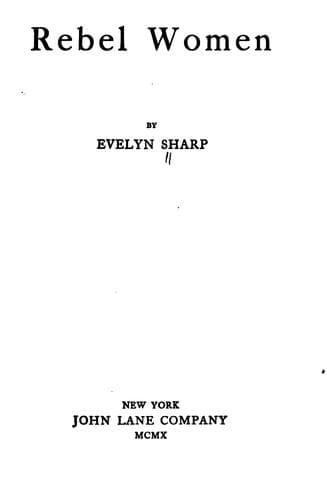
Women -- Great Britain -- Social conditions; Women -- Suffrage -- Great Britain
"We don't ask any questions, and it's best to give no answers," she was
told pleasantly, as they took her across an empty ante-room that seemed
unnecessarily large, into a crowded court that was certainly
unnecessarily small. It was all very still; the wit and the clamour and
the sunshine outside seemed suddenly very far away.
Admitting freely that tradition and fact are at variance in most
countries, one felt that the little judgment hall, with its want of
space, of sunlight, of air and sound and all the things that matter, was
strangely at war with the accepted notion of the publicity of British
justice. The British public was there, it is true--a dozen strong,
perhaps, very self-conscious, and eaten up with pride at having
succeeded in getting past the constable at the door. But it was a
distinctly exclusive, not to say private, sort of public.
One forgot all this, however, when the magistrate came in and began to
hear the cases. There were a good many, and they were heard with
extraordinary rapidity. I suppose the offenders knew beforehand what
they were charged with--an advantage they sometimes had over the
magistrate when he mixed up the charge sheets. But the British public,
jammed together on the one bench reserved for it, could only gather
occasionally why this or that person was fined or sent to prison or
remanded. One thing could be clearly deduced from the progress of that
heart-breaking procession of human failures, as they passed, generally
in hopeless silence, from the greyness of the police court to the more
complete greyness beyond. They were all people who had snatched
desperately at the air for some of the colour of life, and had succumbed
helplessly before they found it.
Public-domain text, read in full here on John Shaqi.
Reviews
Reviews
No reviews yet
Be the first to share your thoughts on this work.
Join the Discussion
Join the discussion
Sign in to leave a comment or review.
Sign InorCreate an account