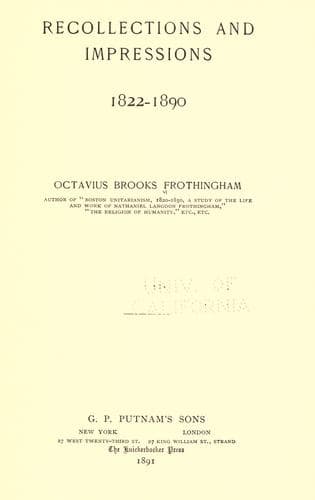
Recollections and Impressions, 1822-1890Frothingham, Octavius Brooks
Religion
Recollections and Impressions, 1822-1890
Frothingham, Octavius Brooks
Frothingham, Octavius Brooks, 1822-1895; Unitarians -- New England -- Biography
Whether Emerson's constant belief in the Over-soul, his stubborn theism,
his persuasion of an immanent God, was an advantage or a disadvantage to
his philosophical view of the universe may be doubted. On the one hand,
we cannot question the fact that he owed to it his enthusiastic faith in
the substantial unity of creation, his optimism, his assurance of future
progress, his confidence in man, his moral earnestness, his elevation of
soul, his buoyancy of spirit, his forwardness in all endeavors after
reform. On the other hand, it can hardly be denied that it led him to
take some things for granted, diverted his mind from the unprejudiced
observation of phenomena, prevented his rendering full justice to the
scientific method, was the cause of wide aberrations in his estimates of
human character, and of a curious onesidedness in his judgments on human
condition.
Emerson was always profoundly religious, at heart a supernaturalist. The
blood of centuries of pious ancestors was in his veins. His soul was
uppermost, not his intellect nor his heart. He was a closet man, a
minister at the altar. True, he rejected every form of the religious
sentiment, and moved with entire freedom among dogmas however expressed
in word or in rite. Every attempt at giving voice to spiritual emotion
was disagreeable to him.
I like a church; I like a cowl;
I like a prophet of the soul;
And on my heart monastic aisles
Fall like sweet strains or pensive smiles;
Yet not for all his faith can see
Would I that cowled churchman be.
Theology had fallen from him like a shroud. He would not venture any
definition of the spiritual laws. Doctrine had become faith; prayer was
changed into aspiration; the speechless utterance was the only one he
cordially listened to. But faith he held fast; aspiration he cherished;
the inarticulate language of the eternal was ever in his ears.
Ever and anon would come a burst of conviction. "Oh, my brothers, God
exists!" he cries in an ecstasy of emotion. Some years ago Emerson
seemed fascinated by the inductive method, so that some of his admirers
thought he would become a convert to physical science. But the bent of
his nature asserted itself, and he pursued the deductive system as
before. His passion for "First Truths," as they were called, was
irresistible. He could not abandon the philosophy of intuition, and all
his studies--comprehensive, profound, and original as they were,--his
insatiable thirst for knowledge, his inordinate appetite for details of
fact, incidents, anecdotes, gleanings from literature of every kind,
were subservient to this.
Public-domain text, read in full here on John Shaqi.
Reviews
Reviews
No reviews yet
Be the first to share your thoughts on this work.
Elsewhere in the archive
Join the Discussion
Join the discussion
Sign in to leave a comment or review.
Sign InorCreate an account