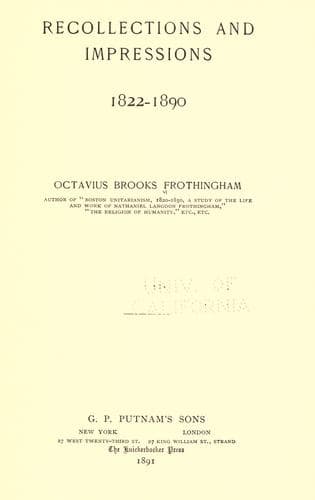
Recollections and Impressions, 1822-1890Frothingham, Octavius Brooks
Religion
Recollections and Impressions, 1822-1890
Frothingham, Octavius Brooks
Frothingham, Octavius Brooks, 1822-1895; Unitarians -- New England -- Biography
Emerson's serenity is often spoken of as evidence of the power of his
religious faith. It may allow of this construction, but it may be
accounted for on other and different grounds which lie nearer at hand
and proceed immediately from more obvious sources. How far may a long
ancestral experience in devout meditations, practices, longings, worked
into the system and producing a sedate, calm, interior temperament, go
in explaining that almost imperturbable tranquillity? The piety of his
forefathers was so genuine that it drove him from the church of his
adoption, and rendered another calling sacred. Their descendant
exhibited the same saintliness which they possessed but in a different
fashion. And he was probably saintlier than they were, because he was
their child. His brothers had the same characteristic of equanimity by
virtue of the same parentage. His brother William, whom I knew
intimately in New York, showed in his daily life a similar dignity, and
tradition reports the same of Charles. It was the perfect fruitage of
centuries of heavenly-minded men, not the peculiarity of an individual
soul.
This predisposition to inwardness was favored by the long seclusion of
Concord, which kept Emerson aloof from the world and prevented the
friction which is so damaging to serenity. He saw those only who
respected, loved, honored, and revered him. He came into collision with
none. Men of thought, unambitious men, students, farmers, were his
fellow-townsmen. Several hours in each day he was alone with his books
or his mind. When he visited the city it was for an intellectual or
social purpose, as one who had dropped from a star and was soon to
vanish. His contact was with men of letters, clergymen, publishers,
friends, gentlemen interested in mental pursuits who had left their
business in order to disport themselves in the fields of thought. These
added to his stores of wisdom, and sent him home replenished rather than
drained. The gains of his day were not dissipated either by business
occupation or pleasure.
Then, whether from disposition or philosophy we cannot tell, this man
avoided everything dark, evil, unwholesome, unpleasant. Sickness of all
kinds, complaint, depression, melancholy, was an abomination to him. He
turned away from ugly sights and sounds, thus evading conflict. He never
argued, never discussed, but said his word as well as he could, and
encouraged others to say theirs, in this way hoping to get at the truth.
By this course he escaped the usual provocations to ill-temper, and was
forced upon an undisturbed equipoise of mind. Nothing helps serenity so
much as avoidance of contest, and when one can thoroughly convince
himself that there is no rooted evil in the world to be fought against,
an even condition of soul is not hard to maintain; optimism is
proverbially cheerful, but an optimism that is grounded in principle
must be unconquerable by any force that circumstances can bring against
it.
Public-domain text, read in full here on John Shaqi.
Reviews
Reviews
No reviews yet
Be the first to share your thoughts on this work.
Elsewhere in the archive
Join the Discussion
Join the discussion
Sign in to leave a comment or review.
Sign InorCreate an account