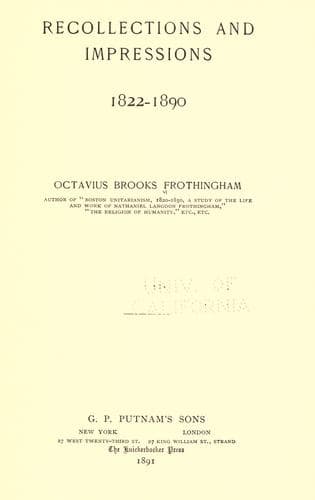
Recollections and Impressions, 1822-1890Frothingham, Octavius Brooks
Religion
Recollections and Impressions, 1822-1890
Frothingham, Octavius Brooks
Frothingham, Octavius Brooks, 1822-1895; Unitarians -- New England -- Biography
I am not sorry that the place and occasion require me to make this
a popular theme. I am not to speak for philosophers, but for the
people. I wish to meet the questions which arise in all minds that
have awaked to any degree of reflection upon their nature and
being, and upon the collective being of their race. I have hoped
that I should escape the charge of presumption by the humbleness of
my attempt--the attempt, that is to say, to popularize a theme
which has hitherto been the domain of scholars.
The lecture assumes the existence of a Personal God, the reality of a
conscious soul, the freedom of the human will, the fact of a moral
purpose in creation, the perfectibility of man, the idea of progress,
the evidence of design in the universe attesting a divine intelligence.
The treatment nowhere shows metaphysical acumen or speculative insight.
On every page is brilliancy, eloquence, skilful manipulation of
arguments, fervent appeal to conscience. Nowhere is subtilty or depth of
intuition. Take for example the discourse on "The Problem of Evil," the
most intellectually exacting of all subjects. It ends thus after a
series of pictures:
Give me freedom, give me knowledge, give me breadth of experience;
I would have it all. No memory is so hallowed, no memory is so
dear, as that of temptation nobly withstood, or of suffering nobly
endured. What is it that we gather and garner up from the solemn
story of the world, like its struggles, its sorrows, its
martyrdoms? Come to the great battle, thou wrestling, glorious,
marred nature! strong nature! weak nature! Come to the great
battle, and in this mortal strife strike for immortal victory! The
highest Son of God, the best beloved of Heaven that ever stood upon
earth, was "made perfect through suffering." And sweeter shall be
the cup of immortal joy, for that it once was dashed with bitter
drops of pain and sorrow; and brighter shall roll the everlasting
ages, for the dark shadows that clouded the birth-time of our
being.
This is not argument, but preaching--- very fine, stimulating, powerful
preaching, but preaching nevertheless; quite different from James
Martineau's treatment of the same theme, in the course of the Liverpool
lectures (delivered in 1839). Mr. Martineau, too, addressed a popular
assembly, and closed his discourse in a strain of exhortation. Still,
the grave tone of the previous discussion sobered the rhetoric, and the
background of the ancient debate made the moral lessons solemn.
Philosophy yielded to the necessities of ethics, much as the "Kritik der
Reinen Vernunft" gave place to the "Kritik der Practischen Vernunft" of
Kant--the preacher and the reasoner standing indeed on different ground,
but the moral instruction being tempered by the philosophical.
Public-domain text, read in full here on John Shaqi.
Reviews
Reviews
No reviews yet
Be the first to share your thoughts on this work.
Elsewhere in the archive
Join the Discussion
Join the discussion
Sign in to leave a comment or review.
Sign InorCreate an account