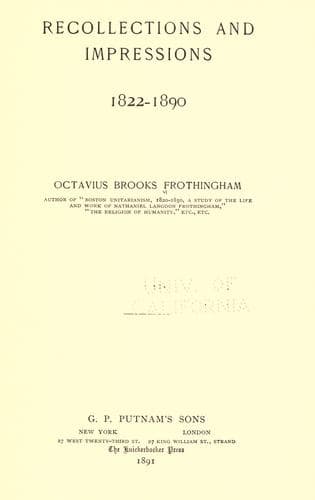
Recollections and Impressions, 1822-1890Frothingham, Octavius Brooks
Religion
Recollections and Impressions, 1822-1890
Frothingham, Octavius Brooks
Frothingham, Octavius Brooks, 1822-1895; Unitarians -- New England -- Biography
If I were to propose a plan to meet the duties and perils of this
tremendous emergency that presses upon us, I would engage the whole
power of this nation, the willing co-operation of the North and the
South, if it were possible, to prepare this people for freedom; and
then I would give them a country beyond the mountains,--say the
Californias,--where they might be a nation by themselves. Ah! if
the millions upon millions spent upon a Mexican war could be
devoted to this purpose,--if all the energies of this country could
be employed for such an end,--what a noble spectacle were it for
all the world to behold, of help and redemption to an enslaved
people! What a purifying and ennobling ministration for ourselves!
The intimacy with Dr. Charming re-inforced the conclusions which were
native to Dr. Dewey's temperament. The moderate view, the dread of
overstatement, the fear of fanaticism, the faith in reason, the love of
tranquillity, the desire after truth, were rooted in his mind. His
constitutional conservatism was confirmed. Then he was a Unitarian, and
therefore rational in his methods, inclined to judge by arguments, to
sift opinions by the understanding. The abolitionists were, for the most
part, either Calvinists or transcendentalists, people who followed an
inward voice, who placed interior conviction before ratiocination, and
encouraged moral sentiment to take the lead in action, blowing coals
into a flame, and not content unless they saw a blaze. The Unitarians,
as a class, were not ardent disciples of any moral cause, and took pride
in being reasoners, believers in education, and in general social
influence, in the progress of knowledge, and the uplifting of humanity
by means of ideas. The habit of discountenancing passion may have been
fostered in a school like this. Perhaps if young Dewey had continued in
his old belief he would have been a more vehement reformer than he was.
His natural glow was softened down into a mild effulgence, communicating
warmth to his convictions, but not producing a burning zeal for any
substance of doctrine.
His power of emotion made him a powerful preacher but prevented his
being a great philosopher. Dr. Bellows, who was his close friend for
many years, described him as a man of "massive intellectual power," and
then went on to impute to him the gifts that belong to the pulpit
orator: "poetic imagination," a "rare dramatic faculty of
representation." Perhaps by "massive" Dr. Bellows meant the power to
throw thoughts in a mass, with cumulative effect. This power Dr. Dewey
certainly possessed in an extraordinary degree. But of philosophical
talent he had little. Indeed, he seemed to be conscious of this himself.
At the end of his first lecture before the Lowell Institute he said:
Public-domain text, read in full here on John Shaqi.
Reviews
Reviews
No reviews yet
Be the first to share your thoughts on this work.
Elsewhere in the archive
Join the Discussion
Join the discussion
Sign in to leave a comment or review.
Sign InorCreate an account