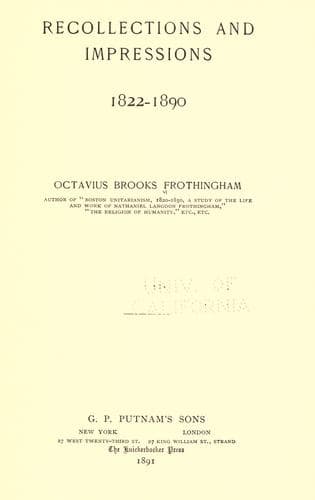
Recollections and Impressions, 1822-1890Frothingham, Octavius Brooks
Religion
Recollections and Impressions, 1822-1890
Frothingham, Octavius Brooks
Frothingham, Octavius Brooks, 1822-1895; Unitarians -- New England -- Biography
I claim, against a strictly logical empirical method, three classes
of facts: first, the authentic facts of the Moral Sense, whenever
it appears as the transcender of the ripest average utility;
second, the facts of the Imagination, as the anticipator of mental
methods by pervading everything with personalty, by imputing life
to objects, or by occasional direct suggestion; third, the facts of
the Harmonic Sense, as the reconciler of discrete and apparently
sundered objects, as the prophet and artist of number and
mathematical ratio, as the unifier of all the contents of the soul
into the acclaim which rises when the law of unity fills the scene.
Upon these facts, I chiefly sustain myself against the theory
which, when it is consistently explained, derives all possible
mental functions from the impacts of objectivity.
If Mr. Weiss had stopped with this general thesis, he would
probably have carried most Rationalists, certainly the mass of
Transcendentalists, with him. They would have been only too glad to
welcome so clear and brilliant a champion. But he insisted on gathering
up these conceptions into two points of doctrine--God and Immortality.
On these points his arguments become strained, and too subtle for
ordinary minds. Indeed, many will be inclined to suspect his whole
exposition, which would be a misfortune of a very grave character. Mr.
Emerson avoided all definite assertion of personality carried beyond the
limits of individuality in the present state of existence. Mr. Weiss is
more daring, and proclaims a God who arranges creation _as it is_, and
an immortality that drops what to most people constitutes their highly
valued possessions--namely, their "animalities" of various kinds. What
will most men think of a God who "takes his chances," who "in
planet-scenery and animal life is at his play," who puts up in his
divine laboratory "curare and strychnine," and cannot "recognize the
word _disaster_," though he makes the thing? To how many will an
immortality be conceivable that can "belong only to immutable ideas,"
that only "springs from the vital necessity of their own souls," that is
a clinging "to the breast of everlasting law"?
To tell the truth, the arguments themselves for this rather questionable
result of idealism are somewhat unconvincing, not to say fanciful. They
are chiefly of a dogmatic kind, that may be met with counter
affirmations, equally valid. Many of them are stated in a symbolical or
poetical or illustrative manner, the most dangerous of all methods.
Examples of this might be multiplied indefinitely. I had marked several
for confirmation, but they were too long for quotation. One instance of
his mode of reasoning may be given[*]:
Public-domain text, read in full here on John Shaqi.
Reviews
Reviews
No reviews yet
Be the first to share your thoughts on this work.
Elsewhere in the archive
Join the Discussion
Join the discussion
Sign in to leave a comment or review.
Sign InorCreate an account