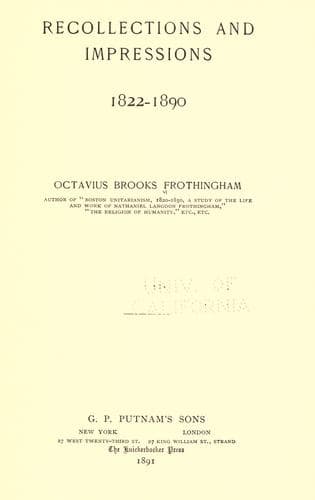
Recollections and Impressions, 1822-1890Frothingham, Octavius Brooks
Religion
Recollections and Impressions, 1822-1890
Frothingham, Octavius Brooks
Frothingham, Octavius Brooks, 1822-1895; Unitarians -- New England -- Biography
It is objected that no thought and feeling have ever yet been
displayed independently of cerebral condition; they must have
brain, either to originate or to announce them. If brain be source
or instrument of human consciousness, what preserves it when the
brain is dead? But there would have been no universe on such terms
as that. What supplied infinite mind with its preliminary _sine qua
non_ of brain matter?
[*] It occurs in "American Religion," p. 149.
But, surely, if this is an argument at all, if it does not beg the very
question in debate--namely, whether there is an infinite mind,--is it
not an argument for atheism? For either the existing universe fully
expresses Deity, in which case Deity is something less than infinite; or
Deity must be conceived as very imperfect, and a progressive, tentative
Divinity is no better than none.
To be sure, he says: "We attribute Personality to the divine Being,
because we cannot otherwise refer to any source the phenomena that show
Will and Intellect." That is to say, we yield to a logical necessity. To
argue that materialism "reeks with immortality" because "the baldest
negation is not merely a verbal contradiction of an affirmation, but a
contribution to its probability,--for it testifies that there was
something previously taken for granted,"--is really a play upon words,
inasmuch as the denial is simply an affirmation of certain facts, and by
no means a categorical declaration involving all the facts at issue. By
claiming none but relative knowledge, the antithesis is removed.
One is conscious of a suspicion that the author's tremendous overflow
of nervous vitality had much to do with the vehemence of his
persuasions. He himself countenances such a suspicion. "I confess," he
declares, "to an all-pervading instinct of personal continuance, coupled
with a latent, haunting feeling that there is a point somewhere in human
existence, as there has been in the past, where animality controls the
fate of men. Where is that point? We recoil from every effort to draw
the line." He had a very strong sense of personality, with its
inevitable reference of persistency. "To us, perhaps," he cries, in a
kind of anguish, "no thought could be so dreadful, no surmise so
harrowing, as that we might slip into nonentity. We impetuously repel
the haunting doubt. We shut the eyes, and cower before the goblin in
abject dread until it is gone. With the beauty-loving and full-blooded
Claudio, we cry,--
Oh, but to die, and go we know not where."
and he quotes the rest of the famous passage in "Measure for Measure,"
adding for himself: "Put us anywhere, but only let us live; and we could
feel with Lear, when he says to Cordelia,--
Come, let's away to prison.
We two alone will sing like birds i' the cage."
Public-domain text, read in full here on John Shaqi.
Reviews
Reviews
No reviews yet
Be the first to share your thoughts on this work.
Elsewhere in the archive
Join the Discussion
Join the discussion
Sign in to leave a comment or review.
Sign InorCreate an account