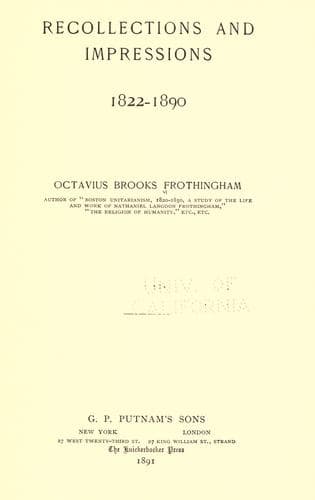
Recollections and Impressions, 1822-1890Frothingham, Octavius Brooks
Religion
Recollections and Impressions, 1822-1890
Frothingham, Octavius Brooks
Frothingham, Octavius Brooks, 1822-1895; Unitarians -- New England -- Biography
All power of growth and service depends, know it or not as we may,
on an ideal faith in somewhat all-sufficient, unerring, infinitely
wise and tender, inseparable from the inmost of life, bent on our
good as we are not, set against our failures as we cannot be. It
means that there can in fact be no philosophy of life, no law of
good, no belief in duty, no aspiration, but must have such
in-dwelling perfection, as being alone reliable to guarantee its
word. This only is my God; infinite ground of all finite being;
essence of reason and good.... When you see a function of memory,
or a law of perfection, let your natural piety recognize it as wise
and just and good and fair. Be loyal to the moral authority that
affirms it ought to be, and somehow must be. Let your _soul_ bring
in the leap of your mind to grasp it. Then, if you cannot see God
in perfect, absolute essence, you will know the Infinite and
Eternal in their relation to real and positive existence; feel
their freedom in your own; know their inseparableness from every
movement of your spiritual being.... The love we feel, the truth we
pursue, the honor we cherish, the moral beauty we revere, blend in
with the eternity of the principles they flow from, and then, glad
as in the baptism of a harvest morning, expanding towards human
need and the universal life of man, our souls walk free, breathing
immortal air. That is God,--not an object but an experience. Words
are but symbols, they do not define. We say "Him," "It" were as
well, if thereby we mean life, wisdom, love.... Must we bind our
communion with the just, the good, the true, the humanly adequate
and becoming to some personal life, some special body of social
circumstances, some individual's work in human progress and upon
human idealism? How should that be, when the principles into which
the moral sense flowers out in its maturity as spiritual liberty,
essentially involve a freely advancing ideal at every new stage
revealing more of God, whom nothing but such universal energy can
adequately reveal?... If then, we cannot see the eternal substance
and life of the universe, it is not because Deity is too far, but
because it is too near. We can measure a statue or a star, and look
round and beyond it; but the Life, Light, Liberty, Love, Peace,
whereby we live and know, and are helpful and calm and free, which
measures and surrounds and even animates us, is itself the very
mystery of our being, and known only as felt and lived. God stands
in all ideal thought, conviction, aim, which ever reach into the
infinite; and thence, as if an angel should stand in the sun, come
attractions that draw forth the divine capabilities within us, as
the sun the life and beauty of the earth. God is the inmost motive,
Public-domain text, read in full here on John Shaqi.
Reviews
Reviews
No reviews yet
Be the first to share your thoughts on this work.
Elsewhere in the archive
Join the Discussion
Join the discussion
Sign in to leave a comment or review.
Sign InorCreate an account