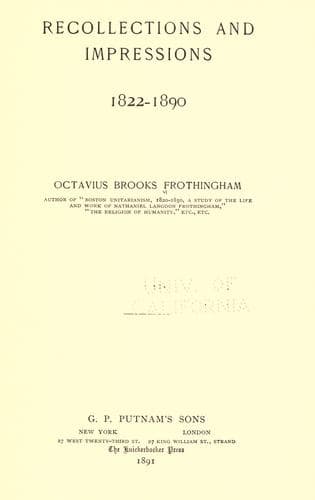
Recollections and Impressions, 1822-1890Frothingham, Octavius Brooks
Religion
Recollections and Impressions, 1822-1890
Frothingham, Octavius Brooks
Frothingham, Octavius Brooks, 1822-1895; Unitarians -- New England -- Biography
the common path, the infinite import of all work we respect, honor,
purely rejoice in, and fulfil; of art, science, philosophy,
intercourse,--whatsoever function befits the soul and the day.
These quotations, which might be multiplied indefinitely, in fact,
which it is difficult not to multiply, are probably enough to satisfy
any who really wish to know that here was a truly religious man, a
really devout man, the possessor of a living faith; one who held fast to
more Deity than the multitude cherished, and welcomed him in a much more
cordial, comprehensive, natural manner; one who fairly drenched the
world and man with a divine spirit, but who was all the more spiritual
on this account, as a man attests his vigor by his ability to lay aside
his crutches, and put the medicine-chest, bottles, and boxes on the
shelf, to walk in cold weather without an overcoat, or lie naked on the
ice and melt it through.
Of course, the only justification of a pretension of this kind is the
actual vitality necessary for such a feat, the sanity demanded by one
who would stand or go alone. In Samuel Johnson's case there was no
question of this. Spiritually, he was a whole man, self-poised,
self-contained, strong, clear, alert, a hero and a saint. His
conversation, his bearing, conduct, entire attitude and manner indicated
the most jubilant faith. He never faltered in his confidence, never
wavered in his conviction, never abated a jot of hope that in the order
of Providence all good things would come. There was something staggering
to the ordinary mind, in his assurance of the divine wisdom and love.
There was something altogether admirable in the elevation of his
character above the trials and vexations that are incident to the human
lot, and that seemed heaped upon him. For his own was not a smooth or
fortunate life, as men estimate felicity. His health was far from
satisfactory. He was not rich or famous or popular or sought after. He
lived a life of labor, in some respects, of denial and sacrifice. Not
until after his death was the full amount of his renunciation apparent
even to those who thought they knew him well.
He was a Transcendentalist--that is to say, he believed in the intuitive
powers of the mind; he was sure that all primary truths, such ideas as
those of unity, universe, law, cause, substance, will, duty, obligation,
permanence, were perceived directly, and are not to be accounted for by
any data of observation or inference, but must be ascribed at once to an
organic or constitutional relation of the mind with truth.
Public-domain text, read in full here on John Shaqi.
Reviews
Reviews
No reviews yet
Be the first to share your thoughts on this work.
Elsewhere in the archive
Join the Discussion
Join the discussion
Sign in to leave a comment or review.
Sign InorCreate an account