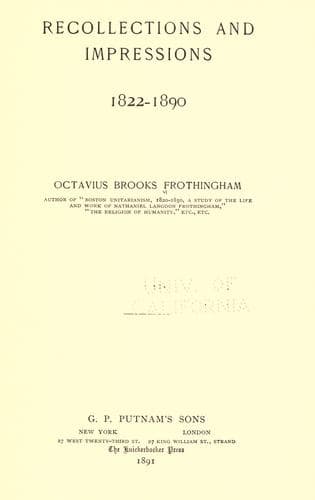
Recollections and Impressions, 1822-1890Frothingham, Octavius Brooks
Religion
Recollections and Impressions, 1822-1890
Frothingham, Octavius Brooks
Frothingham, Octavius Brooks, 1822-1895; Unitarians -- New England -- Biography
But though so ardent a follower of the doctrine that ideas lead the
world, Johnson was not induced to go all lengths with the
sentimentalists. While warmly espousing the cause of the workingman his
papers on "Labor Reform" show how keenly critical he could be of
measures proposed for his benefit. No one will accuse him of
indifference to the claims of woman, but he spoke of "Woman's
Opportunity" rather than of "Woman's Rights"; is inclined to think that
it is not true that she is left out of political life from the present
wish to do her injustice; that "on the whole, the feeling, if it were
analyzed, would be found to be rather that of defending her right of
exemption, relieving her from tasks she does not desire.... Among
intelligent men at least, actual delay to wipe out the anomaly of the
voting rule is not so much owing to a spirit of domination or contempt
as is too apt to be assumed, as it is to a respect for what woman has
made of the functions she has hitherto filled, and the belief that she
holds herself entitled to be left free to work through them alone." He
has nothing to say regarding the superiority of woman's nature; ventures
no definition of her sphere; is not unconscious of feminine infirmities;
doubts the efficacy of the ballot; confesses that the level of womanhood
would be, at least temporarily, depressed by the larger area of
practical diffusion; is by no means certain that women would necessarily
act for their own good, and is deeply persuaded of the inferiority of
outward to inward influence. This is the one thing he is sure of; this
and the principle that "liberty knows--like faith and charity--neither
male nor female." In the war between Russia and Turkey he took the part
of Turkey, not only because he respected the rights of individual genius
and resented invasion, but for the reason that he distrusted the
civilizing tendencies of Russia, and thought the interests of Europe
might be trusted to the Ottoman as confidently as to the Russian. In a
discourse entitled "A Ministry in Free Religion," delivered on the
occasion of his resigning the relation of pastor to the "Free Church at
Lynn," June 26, 1870, he said:
The pulpit has no function more essential than an independent
criticism of well-meaning people in the light of larger justice and
remoter consequences than most popular measures recognize. The
truest service is, perhaps, to help correct the blunders and the
intolerances of blind good-will and narrow zeal for a good cause;
to speak in the interest of an idea where popular or organized
impulse threatens to swamp its higher morality in passionate
instincts and absolute masterships, to maintain that freedom of
private judgment which cannot be outraged, even in the best moral
intent, without mischievous reaction on the good cause itself.
Public-domain text, read in full here on John Shaqi.
Reviews
Reviews
No reviews yet
Be the first to share your thoughts on this work.
Elsewhere in the archive
Join the Discussion
Join the discussion
Sign in to leave a comment or review.
Sign InorCreate an account