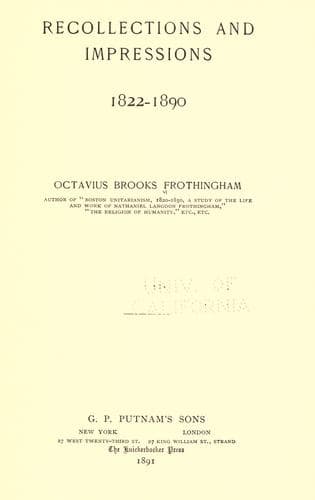
Recollections and Impressions, 1822-1890Frothingham, Octavius Brooks
Religion
Recollections and Impressions, 1822-1890
Frothingham, Octavius Brooks
Frothingham, Octavius Brooks, 1822-1895; Unitarians -- New England -- Biography
In this connection he speaks of temperance, the amelioration of the
condition of the "perishing" or "dangerous" classes, the various schemes
for benefiting the laboring men, plans for adjusting the relations of
labor and capital, arrangements for diffusing the profits of
production,--causes which he had at heart, but which should be discussed
in view of the principle of individual freedom, which must be upheld at
all hazards. He was a close reasoner as well as a warm feeler, and would
not allow his sympathies to get the upper hand of his ideas. He hoped
for the best; he had faith in the highest; he anticipated the brightest;
but he tried to see things as they were. He was a student, not a
sentimentalist, and while he was ready to follow the most advanced in
the direction of spiritual progress, he was not prepared to take for
granted issues that still hung in the balance of debate, or to prejudge
questions that had not been answered, and could not be as yet.
Such moderation and patience are not common with reformers, and few are
independent enough to confess misgivings which are more familiar to
their opponents than to their friends. Candor like this shows a genuine
unconsciousness of fear, a sincere love of truth, an earnest
postponement of personal tastes, ambitions, and connections to the
axioms of universal wisdom and goodness; a loyalty to conviction that is
very rare, that never can exist among the indifferent, because they do
not care, and which is usually put aside by those who _do_ care as an
impediment if not as a snare. In courage of this noble kind, Johnson
excelled all men I ever knew, for they who had it, as some did, had not
his genius, and were spared the necessity of curbing ardor by so much as
their temperament was more passive and their eagerness less importunate.
Of course of the lower sort,--the courage to bear pain, loss, the
misunderstanding of the vulgar, to face danger, to encounter peril, none
who knew him can question his possession. In fact, he did not seem to
suffer at all, so jocund was he, so much in the habit of keeping his
deprivations from the outside world; even his intimates could but
suspect his sorrows of heart.
Samuel Johnson was an extraordinary person to look at. He had large
dark eyes; black, straight, long hair; an Oriental complexion, sallow,
olive-colored; an impetuous manner; a beaming expression. His voice was
rich, deep, musical; his gait eager, rapid, swinging; his style of
address glowing; his aspect in public speech that of one inspired. He
was fond of natural beauty, of art, literature, music; full of fun,
witty, mirthful, social. He was attractive to young people, delightful
in conversation, ready to enter into innocent amusements. His eye for
scenery was fine and quick, his interest in practical science sincere
and hearty, his concern for whatever advanced humanity cordial, and his
freshness of spirit increased if anything with years.
XIV. MY FRIENDS.
Public-domain text, read in full here on John Shaqi.
Reviews
Reviews
No reviews yet
Be the first to share your thoughts on this work.
Elsewhere in the archive
Join the Discussion
Join the discussion
Sign in to leave a comment or review.
Sign InorCreate an account