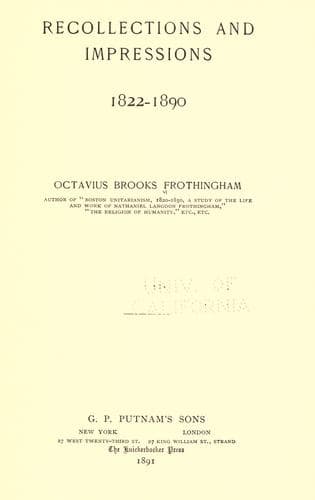
Recollections and Impressions, 1822-1890Frothingham, Octavius Brooks
Religion
Recollections and Impressions, 1822-1890
Frothingham, Octavius Brooks
Frothingham, Octavius Brooks, 1822-1895; Unitarians -- New England -- Biography
It is impossible to mention them all, and to single out a few from a
multitude must not be done. I should like to commemorate those who came
nearest to me by their earnest work and faithful allegiance, but these
cannot be spoken of, and I prefer to enumerate some of those with whom I
was less intimate.
Alice and Ph[oe]be Cary came to New York in 1852, and were prominent
when I was there; their famous Sunday evenings, which were frequented by
the brightest minds and were sought by a large class of people, being
then well established. These were altogether informal and gave but
little satisfaction to the merely fashionable folks who now and then
attended them. The sisters were in striking contrast. Ph[oe]be, the
younger, was a jocund, hearty, vivacious, witty, merry young woman,
short and round; her older sister, Alice, was taller and more slender,
with large, dark eyes; she was meditative, thoughtful, pensive, and
rather grave in temperament; but the two were most heartily in sympathy
in every opinion and in all their literary and social aims. Horace
Greeley, one of their earliest and warmest friends, was a frequent
visitor at their house. There I met Robert Dale Owen, Oliver Johnson,
Dr. E. H. Chapin, Rev. Charles F. Deems, Justin McCarthy and his wife,
Mrs. Mary E. Dodge, Madame Le Vert, and several others.
Among my friends was President Barnard, of Columbia College, the only
man I ever knew whose long ear-trumpet was never an annoyance; Ogden N.
Rood, the Professor of Physics at Columbia, a man of real genius, whose
studies in light and color were a great assistance to artists, himself
an artist of no mean order and an ardent student of photography; Charles
Joy, Professor of Chemistry, a most active-minded man, who received
honors at Goettingen and at Paris, and contributed largely to the
scientific journals; a man greatly interested in the union of charitable
societies in New York; Robert Carter, then a co-worker in the making of
Appleton's Cyclopedia; Bayard Taylor, novelist, poet, translator of
Goethe, traveller; Richard Grant White, the Shakesperian scholar;
Charles L. Brace, the philanthropist; E. L. Youmans a man fairly
tingling with ideas, and peculiarly gifted in making popular, as a
lecturer, the most abstruse scientific discoveries. The breadth of my
range of acquaintances is illustrated by such men as Roswell D.
Hitchcock, of Union Seminary, the learned student, the impressive
speaker; Isaac T. Hecker, the founder of the Congregation of the
Paulists; Dr. Washburn, the model churchman of "Calvary"; Henry M.
Field, editor of the _Evangelist_, a most warm-hearted man, so large in
his sympathies that he could say to Robert G. Ingersoll, "I am glad that
I know you, even though some of my brethren look upon you as a monster
because of your unbelief," and welcomed as an example of "constructive
thought," Dr. Charles A. Briggs' Inaugural Address as Professor of
Biblical Theology at Union College; John G. Holland (Timothy Titcomb), a
Public-domain text, read in full here on John Shaqi.
Reviews
Reviews
No reviews yet
Be the first to share your thoughts on this work.
Elsewhere in the archive
Join the Discussion
Join the discussion
Sign in to leave a comment or review.
Sign InorCreate an account