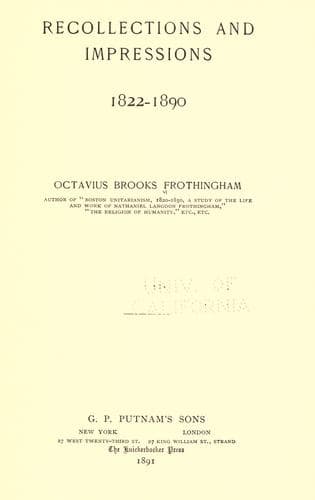
Recollections and Impressions, 1822-1890Frothingham, Octavius Brooks
Religion
Recollections and Impressions, 1822-1890
Frothingham, Octavius Brooks
Frothingham, Octavius Brooks, 1822-1895; Unitarians -- New England -- Biography
In religion, Mr. Ripley's position was the same that it was in
philosophy. In fact the intellectual side of religion interested him
more than the spiritual or experimental side. It was mainly a
speculative matter, where it was not speculative it was practical; in
each event it concerned the head rather than the heart, as being an
opinion rather than a feeling. He was instructed in the school of
orthodoxy, and, as a youth, was strict in his allegiance to the old
system of belief; but he became a disciple of Dr. Channing, and later a
rationalist of the order of Theodore Parker, a friend of Emerson, an
adherent of what was newest in theology. Yet, in this extreme departure
from the views of his early years, he betrayed no sign of agitation, no
trace of internal suffering. He wished to go to Yale instead of Harvard,
because "the temptations incident to a college, we have reason to think,
are less at Yale than at Cambridge." He preferred Andover to Cambridge,
being "convinced that the opportunities for close investigation of the
Scriptures are superior to those at Cambridge, and the spirit of the
place, much relaxed from its former severe and gloomy bigotry is more
favorable to a tone of decided piety." Still, he goes to Cambridge, is
"much disappointed in what he had learned of the religious character of
the school," and, on more intimate acquaintance is impressed by "the
depth and purity of their religious feeling and the holy simplicity of
their lives"; "enough to humble and shame those who had been long
professors of Christianity, and had pretended to superior sanctity." In
1824 a bold article in the _Christian Disciple_, a Unitarian journal,
the precursor of the _Christian Examiner_, excited a good deal of
comment, not to say apprehension. He writes to his sister about it as
follows:
You asked me to say something about the article in the _Disciple_.
For myself, I freely confess that I think it a useful thing and
correct. The vigor of my orthodoxy, which is commonly pretty
susceptible, was not offended. Now, if you have any objections
which you can accurately and definitely state, no doubt there is
something in it which had escaped my notice. If your dislike is
only a misty, uncertain feeling about something, you know not what,
it were well to get fairly rid of it by the best means.
The same year he writes to his mother:
Public-domain text, read in full here on John Shaqi.
Reviews
Reviews
No reviews yet
Be the first to share your thoughts on this work.
Elsewhere in the archive
Join the Discussion
Join the discussion
Sign in to leave a comment or review.
Sign InorCreate an account