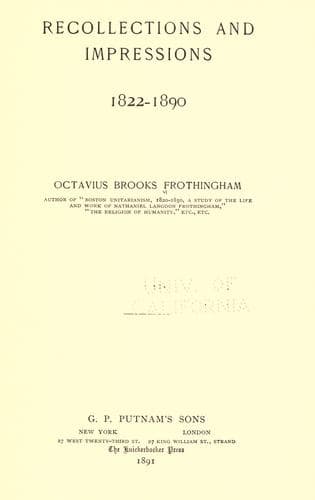
Recollections and Impressions, 1822-1890Frothingham, Octavius Brooks
Religion
Recollections and Impressions, 1822-1890
Frothingham, Octavius Brooks
Frothingham, Octavius Brooks, 1822-1895; Unitarians -- New England -- Biography
I am no partisan of any sect, but I must rejoice in seeing any
progress towards the conviction that Christianity is indeed "_glad
tidings of great joy_," and that in its original purity it was a
very different thing from the system that is popularly preached,
and which is still received as reasonable and scriptural by men and
women, who in other respects are sensible and correct in their
judgments. When shall we learn that without the spirit of Christ we
are none of us His? I trust I am not becoming a partisan or a
bigot. I have suffered enough, and too much, in sustaining those
characters, in earlier, more inexperienced, and more ignorant
years; but I have no prospects of earthly happiness more inviting
than that of preaching the truth, with the humble hope of
impressing it on the mind with greater force, purity, and effect
than I could do with any other than my present conviction.
In 1840 the ministry was abandoned forever, for more secular pursuits.
After 1849 his activities were wholly literary; he had no connection
with theology, and none who did not know his past suspected that he had
once been a clergyman.
The same cast of thought, not "pale" in his case, suffused his action
at Brook Farm and made a Utopia quiet, calm, dignified, pervaded by the
radiance of mind, the gentle enthusiasm of the intellect. The heat came
in the main from other sources. He was receptive rather than original,
inflammable rather than fiery, brilliant rather than warm. The heat was
supplied by those near him, by those he trusted, and by those he loved.
Not that he was deficient in concern for society; far from it; but his
interest was more philosophical than philanthropic. The subject of an
association that should combine intellectual and mechanical labor and
should diminish the distance between the tiller of the ground and the
educator was agitated among the thinkers he was intimate with. Dr.
Channing had such a project at heart. Mrs. Ripley burned with humane
anticipations. Plans for social regeneration were in the air. It was
impossible for one who lived in the midst of ardent spirits, or was
sensitive to fine impressions, or was cultivated in an ideal wisdom that
was not of this world, to escape the contagion of this kind of optimism;
Emerson was saved by his belief in individual growth; Parker by his
steady common-sense; others were protected by their conservatism of
temperament or of association, by their want of courage, or their want
of faith; but men and women of ideal propensities, like Nathaniel
Hawthorne, W. H. Channing, J. S. Dwight, joined the community, which
promised a new era for Humanity. Mr. Ripley would probably have left the
ministry at any rate, for it had become distasteful to him, but it is
not likely that he would have undertaken the management of Brook Farm
unless he had been assured of its success; for he was a New England
Public-domain text, read in full here on John Shaqi.
Reviews
Reviews
No reviews yet
Be the first to share your thoughts on this work.
Elsewhere in the archive
Join the Discussion
Join the discussion
Sign in to leave a comment or review.
Sign InorCreate an account