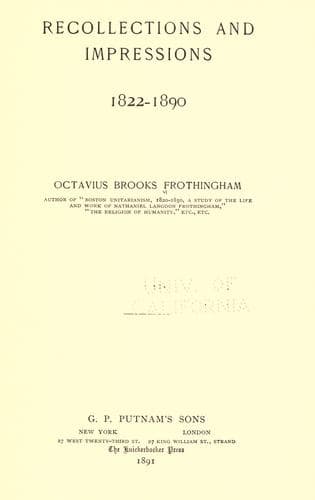
Recollections and Impressions, 1822-1890Frothingham, Octavius Brooks
Religion
Recollections and Impressions, 1822-1890
Frothingham, Octavius Brooks
Frothingham, Octavius Brooks, 1822-1895; Unitarians -- New England -- Biography
The past was distasteful to him and he seldom alluded
to it; but as one puts his childhood and his age together, a steady
development is seen to run through both. His could not be a cloudless
day, but he went on from glory to glory. His age more than justified the
promise of his youth. In his latter years he befriended aspiring young
men; he made literature a power in America; he threw a dignity around
toil; he associated knowledge with happiness, and rendered light and
love harmonious. His favorite author was Goethe, the apostle of culture.
His familiarity with Sainte-Beuve, the master of literary criticism, was
so great, that on occasion of that writer's decease, he sat down and
wrote an account of him without recourse to books. Though without
knowledge of art, destitute of taste for music, and deficient in
æsthetic appreciation, his sympathy was so large and true that these
deficiencies were not felt. The intellectual sunshine was shed over the
entire nature, and the book was so universal that it seemed to embrace
everything.
This is the property of pure mind, rarely seen in such perfection of
lucidity. Such a mind is at once conservative and radical; conservative
as treasuring the past, radical as anticipating improvement in the
future. There is nothing like fanaticism, but a bright look in every
direction, a place for all sorts of accomplishments, hospitality to each
new invention, a radiant acceptance of all temperaments. The mind cannot
be superstitious, for it cannot believe that divine powers are
identified with material objects or occasional accidents; it cannot be
ever sanguine as those are who indulge in abstract visions of good, for
it knows that progress is very slow and gradual, and that the welfare of
mankind is advanced by the process of civilization, by cultivation,
acquirement, refinement, the gains of wealth, elegance, and delicacy of
taste. It judges by rational standards, not by sentimental feelings,
accepting imperfection as the inevitable condition of human affairs and
bounded characters. It is not exposed to the convulsions that accompany
even the most exalted moods, but calmly labors and quietly hopes for the
future.
I do not say that George Ripley was such a mind, merely that his
tendency was in that direction. He was limited by traditions; he had too
many prejudices. The axioms of the transcendental philosophy clung to
him. The shreds of religion hung about him. He could not divest himself
of the ancient clerical memories and ways, nor wholly throw off the
mantle of personal sympathy he had so long worn. He was not completely
secular.
Public-domain text, read in full here on John Shaqi.
Reviews
Reviews
No reviews yet
Be the first to share your thoughts on this work.
Elsewhere in the archive
Join the Discussion
Join the discussion
Sign in to leave a comment or review.
Sign InorCreate an account