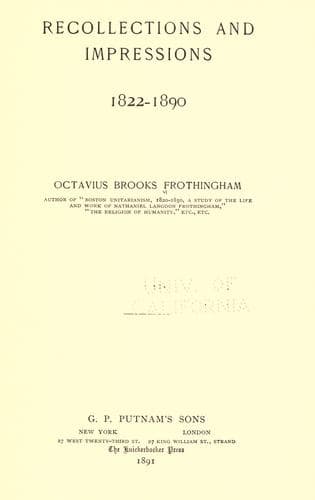
Recollections and Impressions, 1822-1890Frothingham, Octavius Brooks
Religion
Recollections and Impressions, 1822-1890
Frothingham, Octavius Brooks
Frothingham, Octavius Brooks, 1822-1895; Unitarians -- New England -- Biography
Nobody felt the burden of responsibility
as he felt it. Yet he did not flinch for a moment, and his patient
assumption of the indebtedness at last had the stamp of real heroism
upon it. His renewal of the most painful traditions of "Grub Street"
until the liabilities of Brook Farm were cleared off is one of the noble
histories, a history that cannot be told in detail because of the
modesty which has left no record of toil undergone or duty done. The old
simile of the sun struggling with clouds, and gradually clearing itself
as the day wears on, best illustrates my view of this man's
accomplishment. There were the clouds of orthodoxy which were burned
away at Cambridge. Then came the clouds of Unitarian divinity, which
were dispelled by the transcendental philosophy. These were succeeded by
the dark vapors of the ministry, and these by the sentimental
philanthropy of New England rationalism. At length his intellect broke
through these obscurations and showed what it truly was.
On the failure of Brook Farm and the final dismissal of all plans for
creating society anew, Mr. Ripley's faculties emerged in their full
strength. The New England element was withdrawn. There was no longer
thought for theology or reform, but solely for knowledge and literature.
In Boston he had taken on himself every opprobrious epithet. In his
final letter to his congregation he avows his interest in temperance,
anti-slavery, peace, the projects for breaking down social distinctions;
simply, it would seem, because his philosophy, falling in with popular
sentiment, pointed that way; for he was never publicly identified with
any of these causes, or ranked by reformers in the order of innovators.
Indeed, one of the old Abolitionists told me that she had never
associated him with the anti-slavery people, though her family went to
his church. In New York there was no pretence of this kind. The devotion
to literature absorbed his attention. His democratic concern for the
workingmen continued, but in a theoretical manner, if we may judge from
the fact that he took no part in domestic or foreign demonstrations,
that he made no speech, attended no meeting, consorted with no social
reformers, did not even keep up his intimacy with the original leaders
of socialism in this country. When the sadness of his first wife's death
was over, and the drudgery of toil was ended, he was happier than he had
ever been. No time was wasted; no talent was misused. Mental labor was
incessant, but in performing it there was pure delight. It is usual to
think of his early life as his best, and there were some who regarded
him as an extinct volcano; but I am of the opinion that his latter years
were his most characteristic, and that he was most entirely himself when
his intellectual nature came to its full play. In proportion as the
"olden thoughts, the spirit's pall," fell off, he became peaceful and
sweet; his view backward and forward became clear, his purpose steady,
his will serene.
Public-domain text, read in full here on John Shaqi.
Reviews
Reviews
No reviews yet
Be the first to share your thoughts on this work.
Elsewhere in the archive
Join the Discussion
Join the discussion
Sign in to leave a comment or review.
Sign InorCreate an account