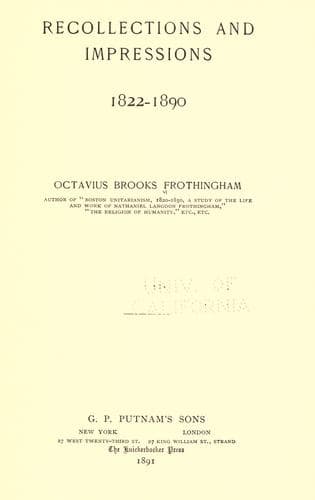
Recollections and Impressions, 1822-1890Frothingham, Octavius Brooks
Religion
Recollections and Impressions, 1822-1890
Frothingham, Octavius Brooks
Frothingham, Octavius Brooks, 1822-1895; Unitarians -- New England -- Biography
Then it must be said he loved money too well. This infirmity was not
native to him, but must probably be imputed to early poverty, the
necessity of working hard in order to pay debts not altogether of his
own contracting, thus pledging the meagre income of the first sixty
years of his life. His final income was large, but it was earned by
incessant literary toil, which naturally rendered him avaricious of the
rewards that might come to him. His generosity did not have a fair
chance to show itself outside of his family. There it was lavish, but
there it was too much mixed up with affection, duty, and pride to be
credited to his manhood. He did not live long enough, either, to attain
complete superiority over his accidents. He was already an old man
before he had money for his wants. I remember meeting him on Broadway in
1861, the year of his wife's death, and he said: "My grief is embittered
by the thought that she died just as I was getting able to obtain for
her what she needed." He was then fifty-nine years of age. It cannot be
expected that any impulse of generosity will overcome the habits of a
life-time at so advanced a period as this. That they showed themselves
at all is remarkable, and establishes as well their power as their
existence.
In a word, this man was too heavily weighted by circumstances to do his
genius full justice. He seemed to be two individuals, with little in
common between them. As one looked at his past or at his present, his
real character was differently judged. The most plausible account of him
was that which supposed the experiences to be buried in a deep grave,
which was seldom uncovered even by the man himself, who lived in the day
before him, and rarely glanced back save to mourn over or to make sport
of his former career. The only way of establishing a unity in his
history is to concede the supremacy of the intellectual quality over the
moral in his first endeavors. The prejudice in favor of the moral was
and is so strong that to maintain this supremacy will seem like a
condemnation of him, though meant in his praise. He probably would so
have considered it, especially when carried away by the flood of
memories. It was easy for him to be mistaken. His merit consists in the
energy of the reason which made headway against a host of disadvantages
and achieved something resembling a victory in the end. Some time hence,
when the homage paid to sentiment shall have yielded to the worship of
knowledge, George Ripley will be regarded as one of the earliest
apostles of the light.
All these greatly enriched my life in New York, opened new spheres of
activity, and enlarged my whole horizon, both intellectually and
socially. Their variety, elasticity, and vigor in many fields of
intellectual force added much to the extension of my view, and acted,
not merely as a refreshment, but also as a stimulus.
XV. THE PRESENT SITUATION.
Public-domain text, read in full here on John Shaqi.
Reviews
Reviews
No reviews yet
Be the first to share your thoughts on this work.
Elsewhere in the archive
Join the Discussion
Join the discussion
Sign in to leave a comment or review.
Sign InorCreate an account