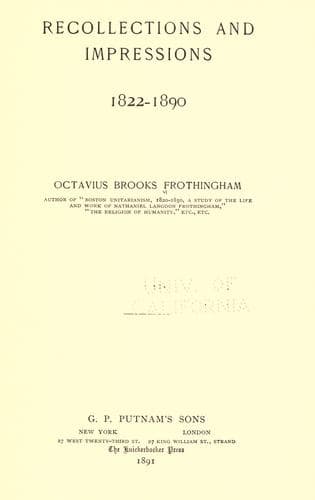
Recollections and Impressions, 1822-1890Frothingham, Octavius Brooks
Religion
Recollections and Impressions, 1822-1890
Frothingham, Octavius Brooks
Frothingham, Octavius Brooks, 1822-1895; Unitarians -- New England -- Biography
The progress of mind is continuous. Strictly speaking, there are no
periods of transition, no crises in thought. The history of ideas
presents no gap. Every stage begins and ends an epoch. One is often
reminded of the common notion that the year begins and ends at a
particular moment. Every day begins and ends a year; every hour is
equally sacred. Yet solemn thought, worship, self-examination, are
precious, and these can be secured only by the observance of times and
seasons; so that we fall on our knees and pray when the old year ends
and the new one begins.
So, as a point of time must be fixed upon, we will begin with Thomas
Paine. It is not easy to speak fully and justly of Paine, because in so
doing we must speak of the misapprehensions and mis-statements of which
he has been the victim; and even if we refute these, the bare mention of
them leaves a stain on his fame. No doubt his method--application of
common-sense to religion--was essentially vicious. Common-sense is an
admirable quality in practical affairs, quite indispensable in the
management of business of all kinds, but it has no place in the
discussion of works of the higher imagination--of poetry, art, music, or
faith. But such was the man's genius, such was the demand of his age. It
is easy to speak of his ignorance, his coarseness, his impudence, his
vanity; but it must be remembered that his education was very imperfect,
for he was utterly ignorant of any language but his own, and he did not,
apparently, read even the English deists; that he was a man of the
people; that he lived in an age of revolutions; that he stood for the
rights of common humanity. It must be remembered also that, in the first
place, he brought the human mind face to face with problems which had
been appropriated by a special class that considered itself exempt from
criticism. In the next place he was in dead earnest; not attacking the
Bible or religion out of flippancy or brutality, but because he really
hated the interpretations that were usually given of sacred things; his
attack was against orthodoxy, not against faith. "His blasphemy," says
Leslie Stephen, "was not against the Supreme God, but against Jehovah.
He was vindicating the ruler of the universe from the imputations which
believers in literal inspiration and dogmatical theology had heaped upon
him under the disguise of homage. He was denying that the God before
whom reasonable creatures should bow in reverence could be the
supernatural tyrant of priestly imagination, who was responsible for
Jewish massacres, who favored a petty clan at the expense of his other
creatures, who punished the innocent for the guilty, who lighted the
fires of everlasting torment for the masses of mankind, and who gave a
monopoly of his favor to priests or a few favored enthusiasts. Paine, in
short, with all his brutality, had the conscience of his hearers on his
side, and we must prefer his rough exposure of popular errors to the
Public-domain text, read in full here on John Shaqi.
Reviews
Reviews
No reviews yet
Be the first to share your thoughts on this work.
Elsewhere in the archive
Join the Discussion
Join the discussion
Sign in to leave a comment or review.
Sign InorCreate an account