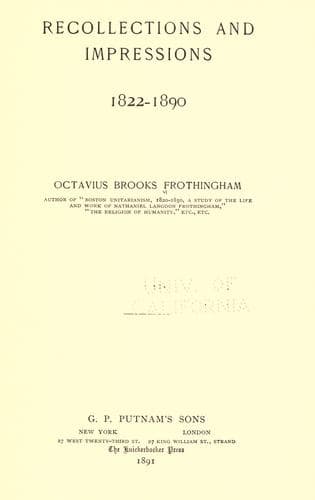
Recollections and Impressions, 1822-1890Frothingham, Octavius Brooks
Religion
Recollections and Impressions, 1822-1890
Frothingham, Octavius Brooks
Frothingham, Octavius Brooks, 1822-1895; Unitarians -- New England -- Biography
unconscious blasphemy of his supporters." Then Paine _did love his
kind;_ he abhorred cruelty, and desired, after his fashion, to elevate
his race.
Examples of this are numerous. At the time when the "Common Sense" and
"Crisis" were having an enormous sale, the demand for the former
reaching not less than one hundred thousand copies, and both together
offering to the author profits that would have made him rich, Paine
freely gave the copyright to every State in the Union. In his period of
public favor and of intimate friendship with the founders of the
government, Paine declined to accept any place or office of emolument,
saying: "I must be in everything, as I have ever been, a disinterested
volunteer. My proper sphere of action is on the common floor of
citizenship, and to honest men I give my hand and heart freely." The
State of Virginia made a large claim on the general government for
lands. Thomas Paine opposed the claim as unreasonable and unjust, though
at that very time there was a resolution before the legislature of
Virginia to appropriate to him a handsome sum of money for services
rendered. In 1797, Paine was the chief promoter of the society of
"Theophilanthropists," whose object was the extinction of religious
prejudices, the maintenance of morality, and the diffusion of faith in
one God. "It is want of feeling," says this _heartless blasphemer_, "to
talk of priests and bells, while infants are perishing in hospitals, and
the aged and infirm poor are dying in the streets." In 1774, Paine
published in the _Pennsylvania Journal_, a strong, anti-slavery essay.
While clerk in the Pennsylvania Legislature he made an appeal in behalf
of the army, then in extreme distress, and subscribed his entire salary
for the year to the fund that was raised. Towards the close of his life,
he devised a plan for imposing a special tax on all deceased persons'
estates, to create a fund from which all, on reaching twenty-one years,
should receive a sum to establish them in business, and in order that
all who were in the decline of life should be saved from destitution. It
is not generally known that Paine often preached on Sunday afternoons at
New Rochelle. In England he spoke in early life from Dissenting pulpits,
and to him we owe this exquisite definition of religion: "It is man
bringing to his Maker the fruits of his heart." All this is evidence
that honorable considerations were at the bottom of his own belief. He
was, according to his view, the friend of man, and in this interest
wrote his books. He introduced kindness into religion.
Public-domain text, read in full here on John Shaqi.
Reviews
Reviews
No reviews yet
Be the first to share your thoughts on this work.
Elsewhere in the archive
Join the Discussion
Join the discussion
Sign in to leave a comment or review.
Sign InorCreate an account