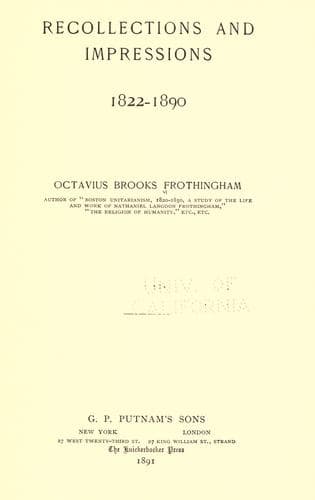
Recollections and Impressions, 1822-1890Frothingham, Octavius Brooks
Religion
Recollections and Impressions, 1822-1890
Frothingham, Octavius Brooks
Frothingham, Octavius Brooks, 1822-1895; Unitarians -- New England -- Biography
Why is not this system sufficient? Simply because the claim that Christ
is God, does not seem made out to severely critical minds. Such as these
must hold even the Broad Church to be a mythology, beautiful and
innocent, but still a mythology. The word "mythology" implies no
disparagement. A mythology is simply the poetical form of an idea, and
takes its character from the nature of the ideas it represents. The
pagan mythology is on this account very different from the Christian,
and a mythology that has universal love as its basis may well be called
innocent and beautiful. To the doctrine of trinity, philosophically
considered, even Unitarian scholars make no objection. What they cannot
accept is the deity of Jesus as an historical person. The Christ is not,
in their opinion, an historical person, but a doctrine, not identical
with the man of the New Testament. The Divine Being has never, in their
estimation, appeared on earth. They only who can put aside criticism,
can suppress it, can regard it but as one of many manifestations of
mind, can fix their eyes on a church for society at large and not for
individuals, will be likely to accept it, and they will on the ground
that it is altogether human, a church for mankind.
The last phase in the development of the moral sentiment is represented
by the "Ethical Societies." It is natural that the origin of these
should be Jewish, for the Jews are unencumbered by the mysteries of the
Christian theology; their genius is for social organization, and the
moral element is very large in their religion. It is natural, too, that
the system should be purer here than in England. Some of the members of
the "Cambridge Ethical Society" are members of the Church of England,
and have to be warned not to set themselves needlessly in opposition to
the work of the Christian churches. The "Edinburgh Ethical Club" is
mainly a debating society. In America it is usual to have a lecturer,
and stated services on Sunday. But these services are very simple, nay,
even bare; there is no prayer, and no scripture, no architecture or art
or poetry; but there is an intense earnestness, nay, enthusiasm, for
social reform. There are kindergartens for the poor children of the
streets, there are classes for the untaught, libraries for the
workingmen, plans for better lodging and employment for the families of
artisans. There is no fixed doctrine in regard to the origin of the
moral sentiments, lest any should be alienated; the object being to
combine all who have at heart the moral interests of mankind. The
peculiarity of these societies is not so much that they lay emphasis on
the moral as distinct from the spiritual interests, or aim to break down
the dividing line between Religion and Ethics, as it is that they rest
upon conscience as the supreme authority, that they assume its practical
function, build upon it as the one and only thing absolutely known.
There is no pretence of following, even at a distance, the charities of
Public-domain text, read in full here on John Shaqi.
Reviews
Reviews
No reviews yet
Be the first to share your thoughts on this work.
Elsewhere in the archive
Join the Discussion
Join the discussion
Sign in to leave a comment or review.
Sign InorCreate an account