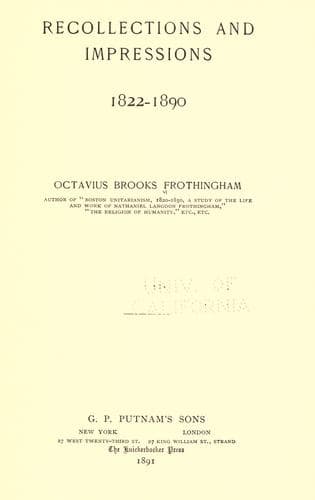
Recollections and Impressions, 1822-1890Frothingham, Octavius Brooks
Religion
Recollections and Impressions, 1822-1890
Frothingham, Octavius Brooks
Frothingham, Octavius Brooks, 1822-1895; Unitarians -- New England -- Biography
the old churches with their vast funds, their immense organizations,
their heaps of tracts, their legions of missionaries, all employed in
calling unbelievers into the fold. The object is to elevate all mankind
by appealing to their moral instincts, on the ground of their inherent
ability to rise in the scale of being.
To make their position clear let me quote the words of the founder of
these societies, contained in an article entitled "The Freedom of
Ethical Fellowship," in the first number of the _International Journal
of Ethics_:
It is the aim of the Ethical Societies to extend the area of moral
co-operation so as to include a part, at least, of the inner moral
life; to unite men of divers opinions and beliefs in the common
endeavor to explore the field of duty; to gain clearer perceptions
of right and wrong; to study with thoroughgoing zeal the practical
problems of social, political, and individual ethics, and to embody
the new insight in manners and institutions....
It would be a wrong and a hindrance to the further extension of
truth to raise above our opinions the superstructure of a social
institution. For institutions in their nature are conservative;
they dare not, without imperilling their stability, permit a too
frequent inspection or alteration of their foundations.... The
subject part of mankind, in most places, might, with Egyptian
bondage expect Egyptian darkness, were not the candle of the Lord
set up by himself in men's minds, which it is impossible for the
breath or power of man wholly to extinguish. It is to this "candle
of the Lord set up in men's minds" that we look for illumination.
It is in the light which it sheds that we would read the problems
of conduct and teach others to read them. We appeal directly to the
conscience of the present age, and of the civilized portion of
mankind. There remains as a residue a common deposit of moral
truth, a common stock of moral judgments, which we may call the
common conscience. It is upon this common conscience that we
build.... The contents of the common conscience we would clarify
and classify, to the end that they may become the conscious
possession of all classes; and in order to enrich and enlarge the
conscience, the method we would follow is to begin with cases in
which the moral judgment is already clear, the moral rule already
accepted; and to show that the same rule, the same judgment,
applies to other cases, which, because of their greater complexity,
are less transparent to the mental eye....
Public-domain text, read in full here on John Shaqi.
Reviews
Reviews
No reviews yet
Be the first to share your thoughts on this work.
Elsewhere in the archive
Join the Discussion
Join the discussion
Sign in to leave a comment or review.
Sign InorCreate an account