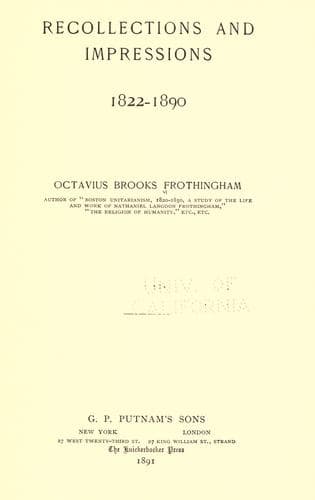
Recollections and Impressions, 1822-1890Frothingham, Octavius Brooks
Religion
Recollections and Impressions, 1822-1890
Frothingham, Octavius Brooks
Frothingham, Octavius Brooks, 1822-1895; Unitarians -- New England -- Biography
Nothing will come of the mutual struggle of the three Christian
families; their equilibrium is as well assured as that of the three
great races which share between them the world; their separation
will secure the future against the excessive predominance of a
single religious power, just as the division of Europe must forever
prevent the return of that _orbis romanus_, that closed circle,
which allowed no possible escape from the tyranny that unity has
engendered.
Moreover, the Roman Catholic faith is essentially _Italian_, and as
such can have no permanent influence in Germany, England, or America.
The great popes of the Middle Ages, whose genius raised the papacy to
power and splendor, were Italians. Italy, until a few years ago, was
isolated; not a great political power, as it is now, among other powers
of Europe, nor drawn by political affiliations into the schemes of other
dominions. Besides, the Catholic Church had the advantages of the
Italian genius for organization, command, wisdom in practical affairs.
Then, too, it had the immense benefit of the old Roman treasures of art,
which gave a glory to the system. These considerations alone would make
it impossible that Romanism, in its foreign form, should ever become the
religion of the United States. There may be another kind of
ecclesiasticism, but without the ancient authority; an ecclesiasticism
which stands for pomp, ornament, display, beauty, but not for anything
more. There is evidence that every form of religion here is disposed to
take on elements of decoration,--architecture, music, stained glass,
drapery, pictures, and monuments; but this is only a sign of increasing
wealth, not of increasing subjection.
In addition to all this, the _genius_ of the American people is
strongly against anything like submission to authority. The love of
liberty is exceedingly powerful. It is claimed that Romanism is not
committed to any form of government, that it is as favorable to
republican institutions as to monarchical; but this is not the opinion
of Renan, who was born and trained in the church, and who is therefore
entitled to speak with knowledge; nor is it the opinion of other
scholars, Martineau for instance, who says in his article on the "Battle
of the Churches" (_Westminster Review_, January, 1851):
We are convinced it cannot occupy the scope which English
traditions and English usage have secured; that every step it may
make is an encroachment upon wholesome liberty; that it is innocent
only where it is insignificant, and where it is ascendant will
neither part with power nor use it well, and that it must needs
raise to the highest pitch the common vice of tyranny and
democracy,--the relentless crushing of minorities.
Public-domain text, read in full here on John Shaqi.
Reviews
Reviews
No reviews yet
Be the first to share your thoughts on this work.
Elsewhere in the archive
Join the Discussion
Join the discussion
Sign in to leave a comment or review.
Sign InorCreate an account