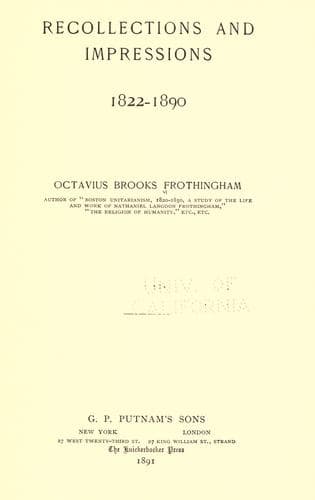
Recollections and Impressions, 1822-1890Frothingham, Octavius Brooks
Religion
Recollections and Impressions, 1822-1890
Frothingham, Octavius Brooks
Frothingham, Octavius Brooks, 1822-1895; Unitarians -- New England -- Biography
There will be a new church founded on moral science, at first cold
and naked, a babe in a manger again, the algebra and mathematics of
ethical law, the church of men to come, without shawm or psaltery
or sackbut; but it will have heaven and earth for its beams and
rafters; science for symbol and illustration; it will fast enough
gather beauty, music, picture, poetry.
Is this the church that Emerson predicted? It looks like it. Already we
seem to hear the shawms and sackbuts. Already there are desires after a
more rich and melodious administration.
The last number of the _International Journal of Ethics_ contains two
articles: one on "The Inner Life in Relation to Morality," the other on
"The Ethics of Doubt," which suggest a transcendental ground for moral
beliefs; and they who dissent from this position surround _action_ with
an ideal solemnity. At all events it is something to see, even at a
distance, a city that hath foundations.
XVI. THE RELIGIOUS FUTURE OF AMERICA.
In the _Revue des Deux Mondes_ of October 15, 1860, M. Renan wrote a
remarkable article on the "Future of Religion in Modern Society." This
paper of course dealt largely with questions that were interesting at
that time, but it also contains very acute observations on the whole
subject, which are of universal concern. His conclusions are that
neither Judaism nor Romanism nor the established forms of Protestantism
will constitute the coming faith, which must be spiritual (that is, free
of space and time), undogmatical, and enfranchised. "The religious
question," he says, "finds its solution in liberty.... The liberal
principle pre-eminently is that man has a soul, that he is to be reached
only through the soul, that nothing is of value save as it effects a
change in the soul. An inflexible justice, granting with inexorable
firmness liberty to all, even to those who, were they masters, would
refuse it to their adversaries, is the only issue that reason discovers
for the grave problems raised in our time." This essay, along with that
of Emile de Laveleye of Liège in Belgium, on the "Religious Future of
Civilized Communities," written in 1876, sums up the whole question. It
only remains to apply their principles to America.
Many dread the prevalence of Roman Catholicism. I confess I never could
share in that apprehension. For if there is anything certain it is the
unchangeableness of the lines of division that separate the three great
regions of the earth, each having its own faith. There is the Greek
Church, which rules in Asia; the Latin Church, which is confined to the
Latin races, and is strongest in Southern Italy, where the people are
most ignorant and supine; and the Protestant Church, which prevails in
Northern Europe among the Germanic nations. As Renan says:
Public-domain text, read in full here on John Shaqi.
Reviews
Reviews
No reviews yet
Be the first to share your thoughts on this work.
Elsewhere in the archive
Join the Discussion
Join the discussion
Sign in to leave a comment or review.
Sign InorCreate an account