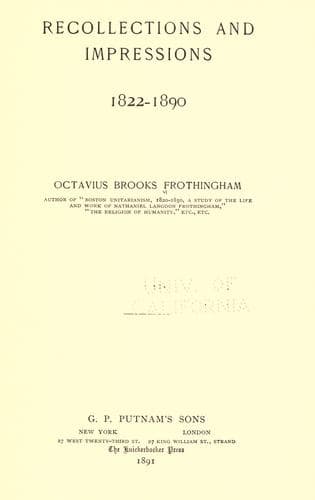
Recollections and Impressions, 1822-1890Frothingham, Octavius Brooks
Religion
Recollections and Impressions, 1822-1890
Frothingham, Octavius Brooks
Frothingham, Octavius Brooks, 1822-1895; Unitarians -- New England -- Biography
The coming religion must also be humane and social. Intellectual it must
certainly be, but it must, too, be emotional and adoring. There are
three implications in it--a spiritual nature in man, a living power in
the universe, an eternal life of progress and attainment, and these are
assured only by reason.
The coming religion, we may add, must be Christian in name, because
Christianity as an ideal faith has worked itself into our common life.
It is the soul of our laws, of our customs, of our institutions. All
assume its authority; all respect its sanction. The great thinkers of
the world conspire in thinking so. Thus Goethe says:
Let intellectual culture progress; let natural science extend our
knowledge; let the human mind grow; it will never outstrip the
grandeur of Christianity, nor its moral culture.
Strauss, in his essay on "The Transient and Permanent in Christianity,"
declares that humanity never will be without religion; and Laveleye
says:
It is Christianity which has shed abroad in the world the idea of
fellowship, from which issue the aspirations after equality which
threaten the actual social order; it is also the influence of
Christianity which arrests the explosion of this subversive force,
and its principles, better comprised and better applied, will bring
back by degrees peace in society.
Ours is a scientific age. There is a general demand for knowledge, a
desire for demonstrated truth. Many will believe nothing that they
cannot see with their eyes. In this sense, and in this sense alone, it
is true that facts count for nothing in the domain of religion. But
there are facts of the inner world that are quite as important as any
facts in the outer world,--facts of the imagination; facts of love;
facts of faith. Nothing is truer than that we are saved by hope. Science
has enlarged the world; has beautified it; has made it look orderly,
harmonious, poetic; but the realm of the known is very small indeed as
compared with the realm of the unknown, and the more we discover, the
more we find that there is to discover. The realm of the inner world is
immensely large; and thousands of years must elapse before we discover
its contents, if we ever do. The language of James Martineau is as true
to-day as it was when the words were spoken, more than fifty years ago:
Public-domain text, read in full here on John Shaqi.
Reviews
Reviews
No reviews yet
Be the first to share your thoughts on this work.
Elsewhere in the archive
Join the Discussion
Join the discussion
Sign in to leave a comment or review.
Sign InorCreate an account