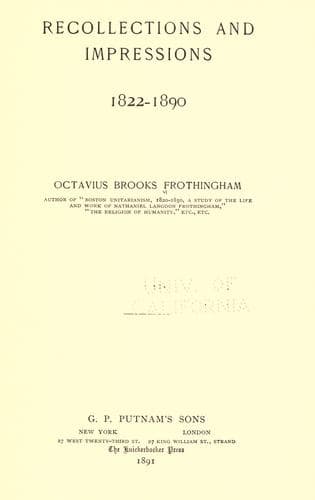
Recollections and Impressions, 1822-1890Frothingham, Octavius Brooks
Religion
Recollections and Impressions, 1822-1890
Frothingham, Octavius Brooks
Frothingham, Octavius Brooks, 1822-1895; Unitarians -- New England -- Biography
Until we touch upon the mysterious, we are not in contact with
religion; nor are any objects reverently regarded by us, except
such as, from their nature or their vastness, are felt to transcend
our comprehension.... The station which the soul occupies when its
devout affections are awakened, is always this; on the twilight
between immeasurable darkness and refreshing light; on the confines
between the seen and the unseen; where a little is discerned and an
infinitude concealed; where a few distinct conceptions stand in
confessed inadequacy, as symbols of ineffable realities.... And if
this be true, the sense of what we do not know is as essential to
our religion as the impression of what we do know: the thought of
the boundless, the incomprehensible, must blend in our mind with
the perception of the clear and true: the little knowledge we have
must be clung to as the margin of an invisible immensity; and all
our positive ideas be regarded as the mere float to show the
surface of the infinite deep.
Shall I say that some form of theism will be the religion of America in
the future? Not the literal theism of a generation or more ago, with its
individual God, its contriving Providence, its supplicatory prayer, its
future of retribution; nor yet the theism of Theodore Parker, of an
infinite God revealed in consciousness, "the Being, infinitely powerful,
infinitely wise, infinitely just, infinitely loving, and infinitely
holy." It well may resemble the system described by Francis W. Newman in
his book called "Theism," published in London in 1858. In this work he
describes a religion based on conscience, without regard to any form of
professed faith, yet covering in its theory and practice the whole
region of ideal ethics. Different minds approach the problem from
different directions. Mr. F. E. Abbot ("Scientific Theism," 1885)
appeals to science; Josiah Royce printed a volume in 1885 entitled "The
Religious Aspect of Philosophy," wherein he pursues the line of
sympathetic thought; James Martineau in his "Study of Religion" (1888),
bases his system on the moral sense; but all three arrive at the same
point--a supreme mind in creation.
Public-domain text, read in full here on John Shaqi.
Reviews
Reviews
No reviews yet
Be the first to share your thoughts on this work.
Elsewhere in the archive
Join the Discussion
Join the discussion
Sign in to leave a comment or review.
Sign InorCreate an account