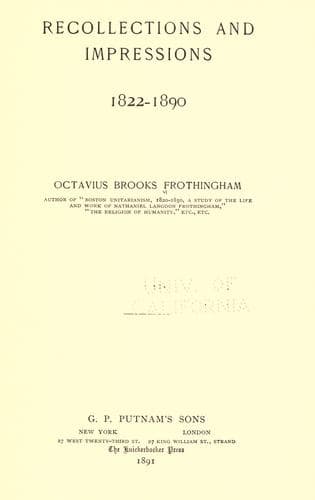
Recollections and Impressions, 1822-1890Frothingham, Octavius Brooks
Religion
Recollections and Impressions, 1822-1890
Frothingham, Octavius Brooks
Frothingham, Octavius Brooks, 1822-1895; Unitarians -- New England -- Biography
The course of spiritual advance is traced with difficulty and
hesitation. It is the most obscure phase of the general problem of
progress, which is almost insoluble. There are so many currents and
counter-currents; so many tributaries; so many swift torrents and still
bays; so many times the stream seems moving in the opposite
direction--it is not surprising if some have concluded that there was no
progress at all, that we only moved in a circle, went over the same
ground again and again, and even marched backwards; what some counted
gain others counted loss. A keen examination suggests that on the whole
advance has been made, allowance being conceded for many a turn and
variation.
The law of evolution may be considered established, but the method of
evolution is hidden. The law of hereditary descent may be admitted, and
yet the lines of hereditary descent are by no means obvious. Tendencies
may even run in parallel lines, may aid each other, may confuse each
other, may neutralize each other, may go very far or lie close at hand,
and in any individual instance it is almost impossible to find how they
work.
In my own case the inferences of temperament followed each other. During
the first fifty years of my life I was mainly under the influence of my
father's temperament. I sang, wrote hymns and poems, sent pieces to the
papers, was sanguine, inclined to take a happy view of all experiences;
but at the same time I was conscious of another train of thought which
struggled fitfully with the first, acquiring more and more power until
at last it gained the ascendency, and I found myself more inclined to
conservatism, as it is called, to a grave, sober, serious regard for
existing institutions and modes of opinion. It is said that this might
have been the effect of years, inasmuch as after middle life one is very
apt to experience a change of sentiment. But in my own case time will
hardly explain the phenomenon, for long before I came to middle age I
was aware of this less hopeful tendency in my constitution. It was my
mother's influence succeeding my father's. And though it never entirely
prevailed, I can see how it may have shadowed my visions of the future.
And it makes me somewhat distrustful of the entire sanity of my
criticism. I am afraid of not being hopeful enough.
Public-domain text, read in full here on John Shaqi.
Reviews
Reviews
No reviews yet
Be the first to share your thoughts on this work.
Elsewhere in the archive
Join the Discussion
Join the discussion
Sign in to leave a comment or review.
Sign InorCreate an account