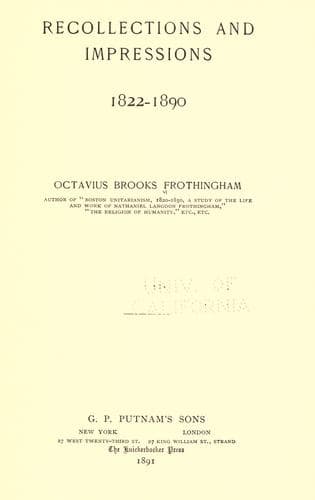
Recollections and Impressions, 1822-1890Frothingham, Octavius Brooks
Religion
Recollections and Impressions, 1822-1890
Frothingham, Octavius Brooks
Frothingham, Octavius Brooks, 1822-1895; Unitarians -- New England -- Biography
I have sometimes suspected myself of a too critical disposition, a
propensity to discover defects in men and opinion, to look at the dark
side of systems that were repudiated; and in the effort to correct the
aberrations of a literal estimate I may have gone too far in the
opposite direction, rendering more than justice to antagonistic
doctrines. But this, if it was an error, was certainly not an error to
be ashamed of. For say what we will, the partial man is not the whole
man, nor is cold perception true perception. There must be sympathy in
every act of judgment, as Dr. Diman wisely wrote ("The Theistic
Argument," p. 32): "In the pursuit of the highest truth not one faculty
but all faculties need to be enlisted." Every system, however formal or
dogmatical it may have become, had in the beginning its spiritual
aspect; it was piously, if not humanely, meant; and in order to be
rightly comprehended, should be surveyed from the inside. The most
repulsive doctrine has something to urge in its favor, and it is the
duty of the true rationalist to find out what it may be.
If the inclination to take a common-sense view of opinions was derived
from my mother's side, a strong democratic bent was primarily due to
her. My grandfather was a poor boy who earned his fortune by the simple
qualities of industry, integrity, perseverance, independence,
faithfulness, honesty,--virtues which he bequeathed to his children.
These inherited dispositions were encouraged by the social influences of
the public school, which, in spite of its laborious method of imparting
a knowledge of Latin and Greek, threw the lads together, thus breaking
down artificial distinctions; and also by my experience at Harvard
College, where scholarship was associated with mere manhood, and was
cultivated by youth of all conditions. The anti-slavery agitation was a
practical instructor in humanity, indicating as it did the widest
sympathy of race. An assumption of the essential identity of all sorts
of mind was a cardinal principle of transcendentalism, while my later
experiences confirmed these early tendencies. My societies in Jersey
City and New York were popular in their composition. The "Free Religious
Association" was based on universal sentiments. The clerical profession
was, in my day, broadly human, so that aristocratic proclivities had
small hope of prevailing. In fact, the lessons which I learned from
R. W. Emerson and Wendell Phillips sank deeply in, and became clearer as
years went on.
Public-domain text, read in full here on John Shaqi.
Reviews
Reviews
No reviews yet
Be the first to share your thoughts on this work.
Elsewhere in the archive
Join the Discussion
Join the discussion
Sign in to leave a comment or review.
Sign InorCreate an account