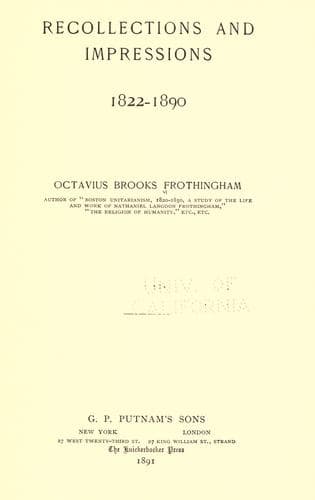
Recollections and Impressions, 1822-1890Frothingham, Octavius Brooks
Religion
Recollections and Impressions, 1822-1890
Frothingham, Octavius Brooks
Frothingham, Octavius Brooks, 1822-1895; Unitarians -- New England -- Biography
Then there is the social world, in which we "live and move and have our
being." This "encompasses us behind and before, and lays its hand upon
us." There is not an hour in the day, hardly a moment of the hour, when
the call of duty is not made upon us. None but the rarest spirits
discharge the claims of mercy and brotherhood; people generally do not
know what they are; repudiate them when presented. The preachers have
more than they can do to induce practice of even the commonest virtues
of good will. Humanity, in its grand aspects, is left to the writers of
Utopias. Not a day passes that conscience is not over-worked, even when
it is not perplexed by misgivings in regard to the amount or the kind of
service it ought to render. Some have sought an escape in the immortal
life from the demands of this; and some have denied the doctrine of
another world because it drew attention away from this, and made the
ills of the present seem light in view of some coming beatitude. In
truth, the friends of that great hope will do well to remember that it
is identical with moral attainment; that it is for great souls; that
The life of heaven above,
Springs from the life below.
It is, to say the least, doubtful whether any future life can do more
than ripen seeds that are sowed here, or whether spiritual perfection
will owe anything essential to other events of time, while it is certain
that nothing is sure to abide but what is born of love.
Unless the doctrine of a future life can be used to reinforce the
doctrine of moral attainment in the present state of existence, its
power must depart. The cords of personal affection are not strong enough
to hold the belief. The true inference from disbelief is not expressed
in the words, "Let us eat and drink for tomorrow we die"; but in these,
"I must work while it is day." This idea is a very old one. The air was
full of it when I was a youth. It was the soul of all liberal faith. The
_Westminster Review_, which was in full force in my early manhood,
having begun in 1824, two years after my birth, was animated by it. The
_Prospective Review_, the organ of the spiritual Unitarians, and edited
by such men as James Martineau, John James Taylor, John Hamilton Thom,
and Charles Wicksteed, a magazine aiming to "interpret and represent
Spiritual Christianity in its character of the Universal Religion," was
started about 1845. In its pages "spirituality" was intimately
associated with "humanity." The books of F. W. Newman, "The Soul"
(1849); "Phases of Faith" (1850); "Catholic Union" (1854), teemed with
this conception. The charming verses of William Blake, published in his
"Songs of Innocence," had somehow came to my knowledge.
To mercy, pity, peace, and love,
All pray in their distress;
And to these virtues of delight
Return their thankfulness.
For mercy, pity, peace, and love
Is God, our Father dear;
And mercy, pity, peace, and love
Is man, His child and care.
Public-domain text, read in full here on John Shaqi.
Reviews
Reviews
No reviews yet
Be the first to share your thoughts on this work.
Elsewhere in the archive
Join the Discussion
Join the discussion
Sign in to leave a comment or review.
Sign InorCreate an account