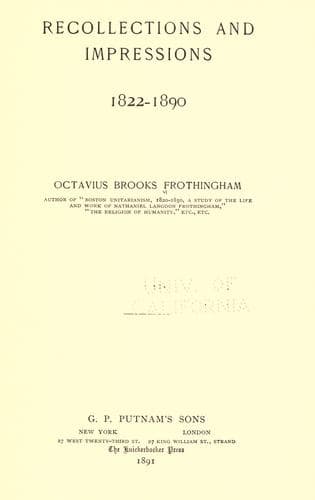
Recollections and Impressions, 1822-1890Frothingham, Octavius Brooks
Religion
Recollections and Impressions, 1822-1890
Frothingham, Octavius Brooks
Frothingham, Octavius Brooks, 1822-1895; Unitarians -- New England -- Biography
For mercy has a human heart;
Pity, a human face;
And love, the human form divine
And peace, the human dress.
Then every man of every clime
That prays, in his distress,
Prays to the human form divine
Love, Mercy, Pity, Peace.
And all must love the human form
In Heathen, Turk, or Jew;
Where mercy, love, and pity dwell,
There God is dwelling too.
In this country the same idea prevailed in the early period of
transcendentalism, and gradually worked its way into the common heart.
Channing lent it an impulse. His brilliant nephew, William Henry
Channing, exemplified it. The transcendental preachers all insisted on
it. The "Dial" was charged with it. The most kindling literature of my
growing days drew inspiration from it. Brook Farm, Fruitlands, and every
other attempt at association was built upon it. Modern socialism owes to
it the fascination it has for the heart; and we cannot listen to a
sermon now that does not throb with the emotion it excites.
For myself I must confess that I have no interest in another life, save
as it encourages the endeavor after this human excellence. My mental
constitution makes me insensible to sentimental considerations, to
arguments addressed to private affections. As my first sermon was about
the brotherhood of man, so my present hope is that love may increase,
and that the reign of theology may be succeeded by that of charity.
This was the dream of Abbot Joachim, in the twelfth century, the
Cistercian monk, founder of the monastery of Floris, author of "The
Everlasting Gospel." It was his notion that the existing era of
Christianity was passing away. According to him, there were three
dispensations, corresponding to the three persons in the Trinity--that
of the Father, that of the Son, that of the Spirit,--the dispensation of
Awe, the dispensation of Wisdom, and the dispensation of Love. The first
was represented by Peter, the organizer, the patron saint of Romanism;
the second, by Paul, the preacher of the Word, the bulwark of
Protestantism; the third by John, the seer, the beloved disciple, the
apostle of love. How much the pious man meant by this we cannot tell.
His own contemporaries were divided in opinion; but a pretty fair
commentary is furnished, in the fact that his writing was condemned by
two Councils--that of the Lateran in 1215, and of Arles in 1260,--and
that he has ever since been classed among the mystics--that is, the
unintelligible and the unbalanced in mind.
Public-domain text, read in full here on John Shaqi.
Reviews
Reviews
No reviews yet
Be the first to share your thoughts on this work.
Elsewhere in the archive
Join the Discussion
Join the discussion
Sign in to leave a comment or review.
Sign InorCreate an account