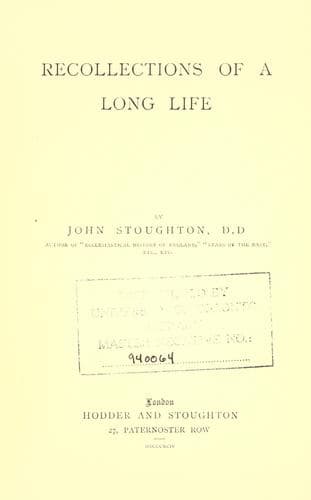
Clergy -- England -- Biography; Stoughton, John, 1807-1897
“On Thursday evening, April 15th, 1874, the Rev. J. Stoughton, D.D.,
an eminent Dissenting minister at Kensington, retired from the
pastorate of his congregation there, after a connection with them
extending over the long period of thirty-three years, during which he
has had the reputation, while upholding the principles of
Nonconformity, of maintaining the most kindly relations with the
neighbouring clergy, and is understood to have enjoyed the respect of
the whole community of Churchmen as well as Dissenters. The ceremony
of last evening was held in Kensington Chapel, a handsome building in
Allen Street, Kensington, where Dr. Stoughton has long ministered,
and his congregation attended in great numbers on the occasion. Mr.
Samuel Morley, M.P., acted as chairman, and there were present, among
others, the Dean of Westminster, Sir Charles Reed, Sir Thomas
Chambers, M.P., Mr. James Spicer, the Revs. W. H. Fremantle, M.A., J.
Angus, D.D., W. M. Punshon, D.D., Donald Fraser, D.D.; F. J. Jobson,
D.D., Henry Allon, D.D., Samuel Martin, and J. C. Harrison, the
last-named of whom, on being called to address the meeting, took
occasion to say that their reverend friend, Dr. Stoughton, though
acquainted with every form of religious thought, had ever held fast
to the Gospel; that, as a minister of religion, it had been quite a
passion with him to be thoroughly fair and impartial; and that he had
all along panted for union among all religious denominations. Later
in the ceremony, the Dean of Westminster, having been called upon to
speak, presented himself to the meeting, and was much cheered. He
said there might perhaps be several reasons why he had been asked to
address them. He could not plead the same long acquaintance as the
previous speakers had claimed with their venerable pastor; but still,
during the last few years of his acquaintance with him, he could
truly say that there had been no occasion of joy or sorrow in his
life on which he had not received some kind sympathy from him. There
was another reason for his addressing the meeting. As a Churchman,
and as a minister of the Church of England, he felt called on to
express his gratitude towards one, not exactly of his communion, who
had never once let fall from his lips a word of bitterness against
the community to which the Dean belonged, and through whose heart he
verily believed the destruction of Westminster Abbey would send a
pang. He only trusted that when the twenty-first century arrived,
and some future pastor of the chapel should write the history of
Queen Victoria’s reign, he would treat his communion with the same
courtesy and appreciation as their present pastor had treated, alike,
divergent ministers and pastors of the Church of the Commonwealth.
He felt he had come there that evening not so much as a personal
Public-domain text, read in full here on John Shaqi.
Reviews
Reviews
No reviews yet
Be the first to share your thoughts on this work.
Elsewhere in the archive
Join the Discussion
Join the discussion
Sign in to leave a comment or review.
Sign InorCreate an account