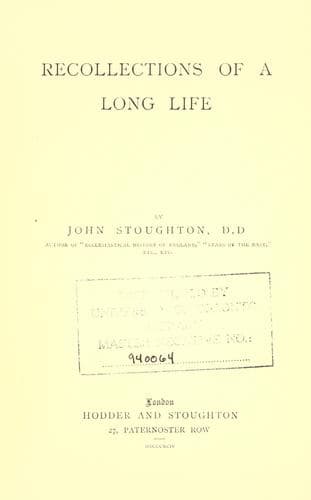
Clergy -- England -- Biography; Stoughton, John, 1807-1897
friend or as a minister of the Established Church, but rather as her
representative of common friends through the writings of Dr.
Stoughton and himself. He came there to express obligations which
dear old friends of them both, who lived two hundred years ago, would
have wished to express on an occasion such as that—Chillingworth,
Jeremy Taylor, Sir Matthew Hale, and many more whom his friend had
brought to one common platform. They had had before his time
histories of the Puritans, where they heard of nothing but Puritans;
they had also histories of the Church of England; but the work of Dr.
Stoughton was the first that had brought those famous men together.
There was, he knew, a charge brought against his friend and himself
that they were not sufficiently good haters. However that might be,
he was sure that Dr. Stoughton hated, as he did, party spirit, the
want of candour, all untruthfulness, and insolent vulgarity, whether
in Church or Nonconformity. All these the Dean hated with a
detestation so complete that, if it were possible, he would be
willing to curse them thirteen times a year. He could not part from
that assembly or from that occasion without saying one word on the
peculiar aspect of the farewell on which the previous speakers had so
touchingly dwelt. Surely it was a transition of life which all of
them might envy as they approached the term of their allotted
existence, to be able to secure for themselves a margin of life and
of comparative quiet before the great end came at last. There was a
custom in old monasteries—he trusted it would not be altogether
inappropriate to mention it at a meeting of Congregationalists—that
when any of the ancient monks had served a term of thirty or forty
years—he forgot which—they were then to be relieved altogether from
their arduous labours; they were to be called by a gentle name which
meant ‘playfellow’; and one condition of their existence was that
nothing that was disagreeable should ever be named in their company.
Such to their friend Dr. Stoughton was the tranquil period through
which he was now passing; and although they might still anticipate
for him long years of active usefulness, whether by pen or by voice,
there must be a delightful sense on his part in looking forward,
having accomplished one period of his existence, to a more
undisturbed time in which he might look back on what had been, and
forward to what was to be to him and all alike. The Dean’s speech,
of which this is necessarily a summary, was repeatedly cheered during
its delivery. A valedictory address, expressed in flattering terms,
and reviewing the long connection between their pastor and the
congregation, was afterwards presented to Dr. Stoughton by Mr. R.
Freeman, on behalf of the Church and congregation, accompanied by the
Public-domain text, read in full here on John Shaqi.
Reviews
Reviews
No reviews yet
Be the first to share your thoughts on this work.
Elsewhere in the archive
Join the Discussion
Join the discussion
Sign in to leave a comment or review.
Sign InorCreate an account