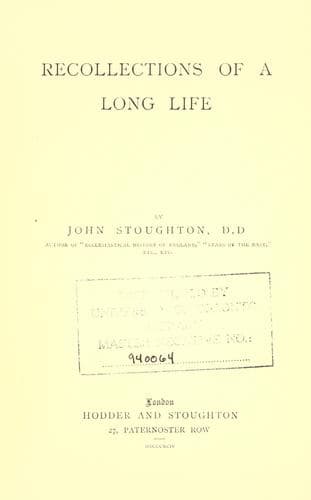
Clergy -- England -- Biography; Stoughton, John, 1807-1897
The main object of my ministrations was the illustration of God’s Holy
Word. Archbishop Whately preferred “to set his watch by the sun”; and,
therefore, tested the results of his own thinking, and other teachers, by
a comparison of them with the decisions of Scripture. When Scripture was
plain, the subject on which it pronounced a distinct judgment was
regarded as fixed for ever. That method it was my desire habitually to
pursue. I made it my aim, not only to interpret the meaning of a
particular verse taken by itself, but to catch, and fix in my mind, the
_drift_ of Apostolic thought in particular instances. It has been said,
irreverently, that some expositors, when persecuted in one verse, flee to
another, and the connection between the several parts of a paragraph is
overlooked and lost.
It was my desire to look at long _trains of thought_ in the writings of
St. Paul as a sacred landscape, in which here and there a verse occurs as
a lofty hill, which serves as a commanding point for surveying a
landscape of thought round about. A single verse is often a key to an
entire paragraph.
It was my habit to go over now and then a large extent of
Scripture—doctrinal, biographical, historical. “Stars of the East, or
Prophets and Apostles,” formed a series of personal sketches in the Old
and New Testaments, afterwards published by the Religious Tract Society.
Another course, called “Lights of the World,” were illustrations of
character, drawn from records of Christian experience and action, such as
“William Tyndale, or Labour and Patience”; “Richard Hooker, or a Soul in
Love with God’s Law and Holy Order”; and “Robert Leighton, or the
Peacefulness of Faith.”
Besides such methods I did not scruple to lay under contribution to the
pulpit, condensed summaries of Puritan works, such as Baxter’s “Now or
Never”; also I may mention that a course of Sermons on “Pilgrim’s
Progress” excited much interest, and three or four of these I repeated at
the close of my pastorate.
As to the real value of a sermon, form must never be confounded with
substance. It is vain to vote the mantle into majesty. A royal robe
depends for effect on the richness of the material, not on the adjustment
of its folds. Toller’s “Sermons” {248} so eulogised by Robert Hall,
depend for their impressiveness, not on a careful selection of words—in
this respect they are open to criticism—but upon the intrinsic majesty of
such thoughts as they express.
There is an obvious contrast between French and English preachers in this
respect. They are more attentive to form than we are. I have witnessed
effects in Parisian, and in Italian churches as well, produced by modes
of delivery, such as I never saw in our own country. Young preachers in
England might make their sermons more effective than they are, by greater
attention paid to a mode of delivery.
Public-domain text, read in full here on John Shaqi.
Reviews
Reviews
No reviews yet
Be the first to share your thoughts on this work.
Elsewhere in the archive
Join the Discussion
Join the discussion
Sign in to leave a comment or review.
Sign InorCreate an account