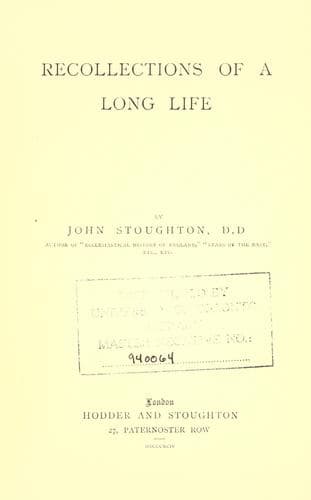
Clergy -- England -- Biography; Stoughton, John, 1807-1897
Let me add a word or two as to preparation from week to week. At the
beginning of a week I chose subjects for the following Sunday; and then
gathered up from day to day, in reading and talking, arguments and
illustrations suggested by books, scenery and conversation. One’s mind
may be brought to such a state as to gather together what is valuable and
useful from time to time, as the magnet attracts to itself grains of
precious metal over which it sweeps. And, let it not be forgotten, we
may sometimes _build_ up a sermon by adding one thought to another; and
at other times _plant_ a sermon through an idea which takes root and
grows into a goodly tree. My method then was, on a Saturday evening, to
_review_ and revise what I had prepared, to criticise its substance and
arrangement, and alter it in matter and form, so that on Sunday morning
it could be poured out to the people in freshness and force.
On week-night services, I sometimes took up Church history, or
archæological illustrations of the Bible. Bible-classes, of course, were
held; but in the latter part of my Kensington pastorate, I was greatly
helped in this, as in other respects by my worthy friend, the Rev. J.
Alden Davies, who was for a few years my assistant minister. {250}
CHAPTER XII
1875–1879
IN my last chapter I brought together two celebrations—one in honour of
John Bunyan, the other in honour of Richard Baxter. Another celebration
now claims attention, not of an English Nonconformist, but of a
Protestant Reformer, whose fame covers the world—Martin Luther. English
commemorations of his character and work were held late in 1875 and early
in 1876.
Before I mention any particulars respecting the Luther celebration, I
repeat what I have said elsewhere:
“There is no other man of a similar order whose fame touches so many
topographical points, and sweeps over so wide a surface. The local
reminiscences of Shakespeare and Milton, even taken together, are
few, and cluster round a metropolis, a provincial town, and two or
three villages. But how many cities, castles, and houses there are
in Germany scattered far and wide which may be said to have Martin
Luther for their presiding genius! Guide-books call attention to
some spot where he went, some fortress or tenement which gave him
shelter, some church in which he preached, some locality which his
name has made famous; and there are scenes and houses unmentioned in
guide-books, over which lingers the spell of his memory. One comes
across mementoes of Charles V. in divers directions; but even they
are fewer, less interesting, and less honoured than those of the monk
who gave the emperor so much anxiety, and who by his devotion, and
energy accomplished the reformation of the Teutonic Church.
Certainly no king, no kaiser, can vie with him as to the place he
occupies in the thoughts of his own people, and indeed of the whole
Christian world.” {252}
Public-domain text, read in full here on John Shaqi.
Reviews
Reviews
No reviews yet
Be the first to share your thoughts on this work.
Elsewhere in the archive
Join the Discussion
Join the discussion
Sign in to leave a comment or review.
Sign InorCreate an account