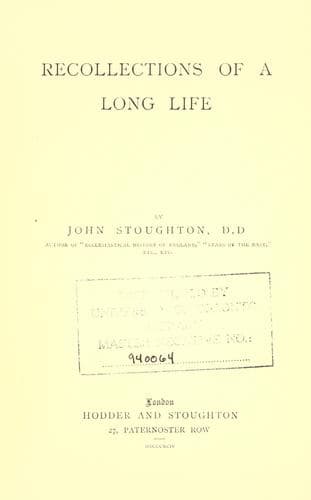
Clergy -- England -- Biography; Stoughton, John, 1807-1897
She was intimately acquainted with foreign celebrities, and her
conversation about them was of much interest. She and her mother, Lady
Elgin, spent some days in Lamartine’s house at Paris, when violent mobs,
during the Revolution, assembled in front of the residence. The
President behaved bravely, but expressed fear lest any insult should be
offered to English ladies under his roof. Mother and daughter, if I
remember right, had been offered refuge by the President when the utmost
peril filled the French capital. Lady Augusta related interesting
anecdotes of Lamartine; and I gathered that he habitually indicated no
small confidence in himself, feeling that he was the greatest man in
France, as no doubt, at the time, he really was.
Her Ladyship and the Dean were well acquainted with M. Guizot, and gave
interesting accounts of that distinguished statesman, and of his habits
and studies after retirement from public life. I happened once, when
talking of Earl Russell, to make the remark, that I had heard of his cold
manner to political acquaintances. Her countenance lighted up, and she
spoke with enthusiasm of what he was in the bosom of his family, and the
circle of intimate friends. Bishop Thirlwall was a great favourite with
her, and she related interesting anecdotes of that distinguished man,
indicating a warm heart, in union with a keen intellect.
Lady Augusta’s visit to St. Petersburg with the Dean, at the marriage of
the Duke of Edinburgh, proved too much for her strength, and at Paris in
the following autumn serious illness set in. From time to time amendment
and relapse excited hope and fear, until all prospect of recovery
vanished. She spoke of friends, sent kind messages, and talked calmly
and with humble confidence of the other world, saying, “Think of me as
near, only in another room. ‘In my Father’s house are many mansions.’”
I had a touching note from the Dean asking me to be a pall-bearer at the
funeral. All chosen for that office indicated causes, classes, and
places in which she felt an interest. Religion, literature, and
philanthropy, the neighbourhood in which she lived, and Scotland—each had
a representative.
The assembly of mourners in the Jerusalem Chamber; the spectacle in the
Abbey; the procession up the nave whilst the Queen occupied a little
gallery not far from the western door; the calm submission of the
bereaved husband, as he sat by the coffin; the solemn entrance into Henry
VII.’s Chapel; the ray of sunlight falling on the coffin as it sank into
the vault; and especially the words, “I heard a voice from Heaven,” sung
by choristers invisible at the moment, as if music came from the Upper
Temple—these incidents can never be forgotten.
Public-domain text, read in full here on John Shaqi.
Reviews
Reviews
No reviews yet
Be the first to share your thoughts on this work.
Elsewhere in the archive
Join the Discussion
Join the discussion
Sign in to leave a comment or review.
Sign InorCreate an account