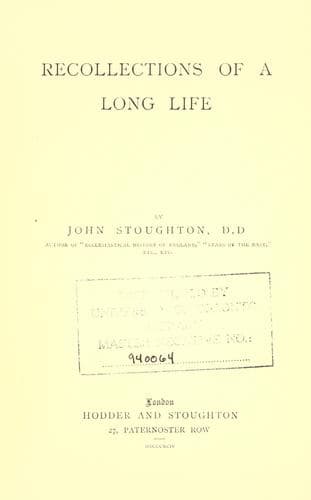
Clergy -- England -- Biography; Stoughton, John, 1807-1897
Washington Irving concludes his essay on “Shakespeare and
Stratford-on-Avon,” by remarking it would have cheered “the spirit of the
youthful bard that his name should become the glory of his birthplace,
that his ashes should be guarded as a most precious treasure, and that
its lessening spire, on which his eyes were fixed in tearful
contemplation, should one day become the beacon towering amidst the
gentle landscape to guide the literary pilgrim of every nation to his
tomb.”
It is no depreciation of Shakespeare’s genius to say that above his
aspirations after fame, whatever they might be, rose the aims and desires
of Luther—a man absorbed in zeal for the salvation of souls, and for the
glory of his Saviour; but it would have filled him with wonder, could he
have foreseen the place he was to occupy in the history of the world, and
how the double tower of the Stadt Kirche, in which he preached, would
become a beacon to guide tens of thousands from both hemispheres to the
Augustinian monastery, where he lived, and to the Schloss Kirche, where
he lies buried.
The Luther Commemoration in England was enthusiastic.
Soon after I left Kensington an immense assembly gathered in Exeter Hall,
to take up points in Luther’s character and work. If I remember rightly,
I dwelt on that occasion at some length on his domestic life, often
assailed by his opponents, but held in admiration by Protestants all over
the world. In lectures and addresses, delivered at Norwich,
Peterborough, Bedford, and elsewhere, I dwelt on his manifold excellences
and achievements, at Leipzig, at Worms, in the Wartburg, and his
Wittenberg home. My remarks accorded with those I have now introduced.
After the close of my pastorate in Kensington, Ealing became my home.
The professorships at New College were continued. Sundays were spent in
preaching the Gospel. Literary studies were pursued to a larger extent
than they had been when pastoral duty claimed chief attention.
In 1876 I was grieved by the death of Lady Augusta Stanley, for she
manifested towards me kindness which could not fail to inspire my warmest
gratitude. I never knew any other person who had so much dignity and
sweetness of demeanour, one who, with many-sided sympathy, could make her
numerous guests feel how sincere were her friendly demonstrations. It
often surprised me, as it did others, how she paid marked attention to
all her guests, however numerous they might be. Her tact was admirable.
Nobody could leave the Deanery with the idea of having been neglected.
Her “At Homes” were extraordinarily popular, for every one was sure of
meeting with notabilities of Church and State, literature and science.
Her husband was in full sympathy with her in all these respects.
Public-domain text, read in full here on John Shaqi.
Reviews
Reviews
No reviews yet
Be the first to share your thoughts on this work.
Elsewhere in the archive
Join the Discussion
Join the discussion
Sign in to leave a comment or review.
Sign InorCreate an account