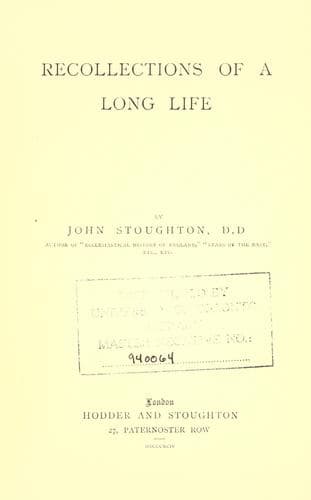
Clergy -- England -- Biography; Stoughton, John, 1807-1897
We visited Oberammergau, and heard much about the Passion Play, and were
conducted to the place of performance, by persons who had taken part in
it. They gave us interesting information. The priest of the place is no
bigot. He insisted that a Protestant, who had died in the village,
should be interred in consecrated ground, for which, we are told, he
received a rebuke from Rome. The drive we had from Partenkirchen to
Mittenwald called forth exclamations of great delight.
In the following winter I mixed with members of various denominations,
some widely separated from others. This led me to think a good deal
about consistency. I noted down at the time considerations of this kind.
Everybody admits the palpable truism, “Truth is true, and falsehood is
false,” and some deduce from that the corollary: “Then stick to the true,
and eschew the false altogether. Countenance what you believe, by
consorting exclusively with such as believe as you do.”
But, it must be remembered, systems are complex, and cannot be fairly
dealt with in the fashion recommended by some. In many cases, what is
condemned as a whole, contains seeds of another sort. There are
estimable people who are not accustomed to analyse what they condemn, and
cannot see what of truth may be found in the midst of error. To look
alone at one side of a system, which, after all, has much of truth, may
involve us in error. Thinking of Divine sovereignty, if not connected
with human responsibility, may land us in Antinomianism; to dwell upon
responsibility by itself, may make us Pelagians.
In the summer of 1882, I went down to Rodborough, in Gloucestershire, to
visit my friend, Sir S. Marling, just made baronet, and to preach, I
think, for the seventh time, on behalf of the Sunday Schools. The
Countess of Huntingdon, George Whitefield, and Rowland Hill had all been
in some way connected with the chapel.
On the occasion now mentioned, there was a large gathering of day and
Sunday scholars, a picture worthy of Wilkie’s pencil. Sir Samuel and his
lady were encircled by guests old and young, receiving from them
demonstrations of affection in loud huzzas.
Public-domain text, read in full here on John Shaqi.
Reviews
Reviews
No reviews yet
Be the first to share your thoughts on this work.
Elsewhere in the archive
Join the Discussion
Join the discussion
Sign in to leave a comment or review.
Sign InorCreate an account