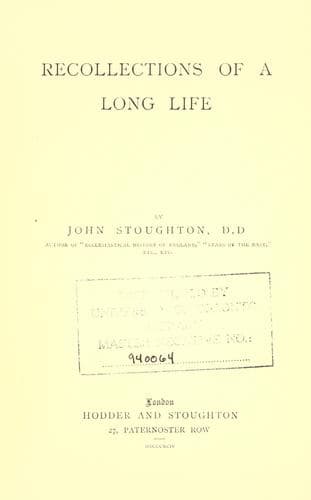
Clergy -- England -- Biography; Stoughton, John, 1807-1897
Soon after my return from Italy I attended meetings connected with
Wesleyan Methodism, when my friend Mr. McArthur, (afterwards knighted),
was Lord Mayor of London. He invited me at different times to meet a
large number of ministers of his own and other communions, and at such
times he manifested the catholic spirit by which he was eminently
distinguished. I think it was once in his mayoralty that the archbishops
and bishops dined at the Mansion House table, when toasts were proposed,
to which the Archbishop of Canterbury had to respond. Afterwards
Nonconformists were honoured in the common way, and it fell to my lot to
reply in a few words. The Archbishop had, in a good-natured style,
referred to the cares and troubles of his right reverend brethren, and
himself. Alluding to what he had said, I ventured to remark I was quite
content with my humbler position, and had no aspirations after a seat on
the Episcopal Bench. Further, I pleaded, as I always do, for catholic
union, and remarked that I strove to be a Christian first; next, a
patriotic religious Englishman; and thirdly, a devout Dissenter, adding
that I should be ashamed of my Nonconformity, if that were so
obstreperous, as to quarrel with the subordinate place I assigned to it.
At the close of the year 1882 Dr. Tait, Archbishop of Canterbury, died.
With him I had the pleasure of being acquainted soon after his
appointment to the See of London. Our relations afterwards were very
friendly. I was kindly invited to share in the pleasure of his Lambeth
hospitality; and at a time of deep domestic sorrow he was one of the very
first to express affectionate sympathy in a letter of condolence. I
found him always very kind, and he impressed me with the conviction that
in his judgment of Conformity and Nonconformity, and of the relative
duties of Churchmen and Dissenters, he took much more sensible views than
most of his brethren. He did not seem to anticipate, as at all probable,
the comprehension of all, or most, English Christians within the pale of
one community; since each denomination has its principles, its
traditions, and its trust property, and is not likely to merge its
peculiarities in the adoption of others. A wise, liberal, Christian
_modus vivendi_ was the object of his desire. I attended his funeral,
and met in his residence at Addiscombe, a large number of clergymen, and
men of different opinions, drawn together by a common regard for his
eminent moral and religious worth. The trees were bare, the ground was
covered with snow, and the long procession walked through the park, the
winter sun brightening the scene. The whole struck me as very solemn,
and in harmony with the occasion that had brought us together.
Public-domain text, read in full here on John Shaqi.
Reviews
Reviews
No reviews yet
Be the first to share your thoughts on this work.
Elsewhere in the archive
Join the Discussion
Join the discussion
Sign in to leave a comment or review.
Sign InorCreate an account