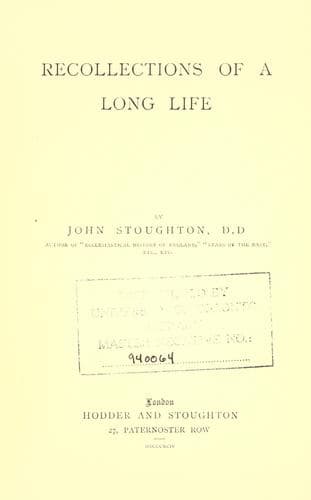
Clergy -- England -- Biography; Stoughton, John, 1807-1897
Seville was headquarters of the Protestant cause. The Reformation did
not penetrate much below the hidalgo class. It left the masses almost
untouched. In Seville stood the Inquisition prison, till it was removed
to a palace in the Calle san Mario. “Here,” says Mr. Wiffen in 1842,
“while gazing on the edifice with feelings of awe, I recalled to
remembrance those martyrs for the truth, and, at the same time, I
listened with painful interest to the narration made to me by a Spanish
gentleman, of an attack on those very premises at a recent period by an
infuriated populace, who suffered but few of the friars confined there
for political offences, to escape with life. The building having taken
fire some perished in the flames, while others fell by the hands of the
assassins.” The tables were turned just then, priests were in prison for
political crimes, as heretics had been incarcerated in the sixteenth
century.
Old Venetian political policy was carried out against Protestantism, and
the Inquisition office, with opened ears, listened for whisperings of
heresy. Horrors went on in secret places. I cannot relate them, but
they may be found in what is written by Limborch and Llorente. A few
miles from Seville is the monastery of San Isidore—the cradle of the
Spanish Reformation—and I visited the building with deep interest. The
chapel remains in tolerable repair, and is used as a parish church. The
chapter-house, sacristy and cloisters are preserved. Ancient pictures
hang on the walls, and old embroidered vestments are shown to visitors.
Bibles and Protestant books were of old secretly brought within the
walls, and monks began to read them.
I have described Seville Cathedral and its treasures at some length in my
volume on “Spanish Reformers, their Memories and Dwelling Places.” I
cannot repeat here what has been said there. But let me say, the city is
full of interest to travellers, hotels are comfortable, shops are well
stocked with curiosities, manufactories are hives of industry, and
pictures by great masters are found in churches and private houses. I
was enchanted with some of the Murillos, and would advise every traveller
to visit the Sala de Murillo in Seville.
I should have been glad to have prolonged my stay, and to have revisited
spots full of historic interest. But I had much before me to see and
study in the interior and north of Spain; therefore, though unwillingly,
we took the train one night for Madrid, making that a starting point for
other explorations.
Public-domain text, read in full here on John Shaqi.
Reviews
Reviews
No reviews yet
Be the first to share your thoughts on this work.
Elsewhere in the archive
Join the Discussion
Join the discussion
Sign in to leave a comment or review.
Sign InorCreate an account